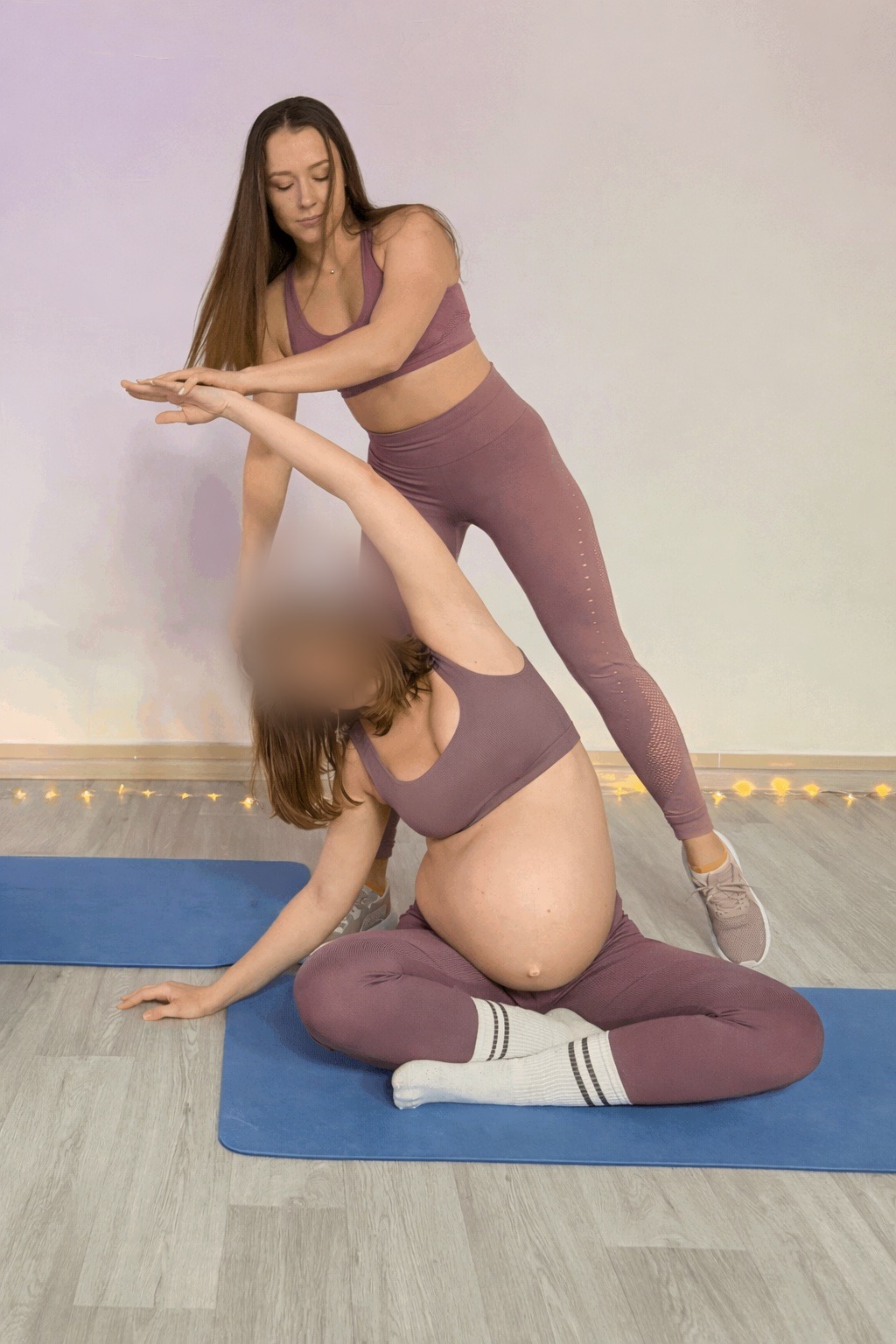
In short. Pregnancy fitness is built around trimesters, not as “the usual training, only easier”. Current clinical guidelines recommend 150 minutes of moderate activity per week in the absence of contraindications – usually 3 strength sessions of 30-40 minutes plus 2-3 cardio sessions. First trimester (1-13 weeks) – maintain the usual routine with adjustments for nausea and fatigue, exclude jumping and exercises with a fall risk. Second (14-27 weeks) – the most productive period, active strength and cardio work. Third (28-40 weeks) – focus on breathing, pelvic mobility, relaxation, with no supine position, crunches, or impact loads. Universal exercises for all trimesters: diaphragmatic breathing, Kegels, walking, swimming, cat-cow, wall squats. Absolute contraindications: threatened miscarriage, placenta praevia, cervical insufficiency, severe pre-eclampsia. Stop-signals during a session: spotting, cramping pain, dizziness, breathlessness at rest, leaking fluid.
Current clinical guidelines recommend 150 minutes of moderate activity per week in pregnancy – that is 30 minutes five days a week, and consistency here matters more than the intensity of any single session.
Pregnancy is not a contraindication to training, but a reason to structure it properly. The body changes not only in the intensity it can handle, but in the very logic of the load. What was optimal in the first trimester stops being right in the third – not because it is “hard”, but because the body works differently.
This guide is built from practice with women at all stages, drawing on current obstetric clinical guidelines and systematic reviews of evidence-based recommendations.
Contents
- Why “do as before, only easier” is the wrong approach
- General principles of pregnancy fitness
- What changes by trimester – a short map
- First trimester: 1-13 weeks
- Second trimester: 14-27 weeks
- Third trimester: 28-40 weeks
- Universal exercises for all trimesters
- What to avoid in any trimester
- How to adapt familiar workouts
- A ready-made weekly plan by trimester
- Stop-signals: when to end the session
- When you need a doctor, and when a trainer
Why “do as before, only easier” is the wrong approach
A common line of thinking: reduce intensity and everything will be fine. In practice this works badly. Pregnancy changes:
- The position of the centre of gravity. By the end of the second trimester it shifts forward and upward, which changes the biomechanics of any movement, especially standing.
- Joint mobility. Relaxin makes the ligaments more pliable. Sharp movements at maximum amplitude become more dangerous than before.
- Blood volume. Increases by 40-50% by the third trimester. The heart works harder even at rest, and the available training zone narrows.
- Breathing. A growing uterus restricts the diaphragm, and a familiar load can cause breathlessness more quickly.
- The pelvic floor. It carries the weight of the uterus and the baby. Jumping and impact loads push down on tissues that are already overloaded.
- Intra-abdominal pressure. Any work with breath-holding or bearing down increases the risk of diastasis and provokes uterine tone.
This means you need not just lighter weights, but a different programme – with different priorities and different exclusions.
General principles of pregnancy fitness
A few universal rules that apply at every stage.
Consistency matters more than intensity. 30 minutes five times a week works better than an hour once a week. Current guidelines recommend 150 minutes of moderate activity per week in the absence of contraindications.
The talk test. If during cardio you can speak in full sentences, the intensity is appropriate. If you are out of breath – it is too high.
The pelvic floor is part of every session. Not a separate 5-minute block once a week, but integrated work: breathing plus activation on every lift, on every change of position.
Breathing without holds. Any effort on the exhale. No bearing down. This rule matters more than the choice of any specific exercise.
Listen to the body, not the calendar. The week count is a reference, not a command. If at 30 weeks you feel well, the programme can be fuller than a generic template for the third trimester. And the other way round: when you feel poor at 14 weeks, the programme shrinks.
Do not start intense disciplines from scratch. If you did not run before pregnancy, do not start now. If you trained before, you can adapt. Pregnancy is not the time for new records and learning complex skills.
Water, coolness, heart rate control. Overheating in the first trimester may affect foetal development. Do not train in the heat, always have water with you, and do not push to heavy sweating with flushed skin.
What changes by trimester – a short map
| Parameter | 1st trimester | 2nd trimester | 3rd trimester |
|---|---|---|---|
| Dominant feeling | Fatigue, nausea | Energy, productivity | Heaviness, breathlessness |
| Blood volume | +10-15% | +30-40% | +40-50% |
| Relaxin | Active, moderate | Active | Peak |
| Supine position | Allowed | From mid-trimester – limited | Excluded |
| Jumping and running | As tolerated | As tolerated | Not recommended |
| Strength work | Adapted | Active | Reduced |
| Main focus | Maintain the routine | Strength and cardio | Birth preparation |
| Pelvic floor | Activation | Active work | Relaxation + breathing |
First trimester: 1-13 weeks
The main task of the first trimester is not “to start training on a special programme”, but to maintain the usual level with adjustments for how you feel.
What is happening:
- A surge of progesterone – sleepiness, slower digestion.
- Nausea in 70-80% of women.
- Blood volume starts to grow – quick fatigue.
- Relaxin starts to work – ligaments become more pliable.
- Externally the body has barely changed.
What suits:
- Walking – a base no matter how you feel.
- Strength training – continue if you trained before pregnancy; start with basics if you did not.
- Swimming – an ideal choice, especially with nausea.
- Yoga for pregnant women – without inverted poses, without breath retention.
- Stretching – controlled, without maximum amplitude.
What to exclude:
- Sports with a fall risk (off-road cycling, horse riding, skiing, rollerblading).
- Contact sports.
- High jumps with one-leg landings.
- Workouts with breath-holding and maximum effort.
- Overheating (hot yoga, sauna after training, banya).
Main first-trimester mistakes:
- Dropping everything abruptly “just in case” – often worse for tone and mood than continuing moderate load.
- Ignoring nausea and training through it. If you feel bad, skip the day.
- Hiding the pregnancy from the trainer and continuing in a group at the previous load.
In detail: first trimester training.
Second trimester: 14-27 weeks
The second trimester is usually the most productive for training. Nausea is gone, the belly is not yet a major hindrance, energy returns. This is the best window for serious work.
What is happening:
- Blood volume has grown significantly – the heart works harder.
- The belly starts to show, the centre of gravity shifts.
- The chest grows – a supportive top is needed.
- Load on the lower back and pelvis increases.
- By the end of the trimester – restrictions on the supine position (vena cava syndrome).
What suits:
- Full strength training 2-3 times a week.
- Cardio 30-40 minutes – walking, stationary bike, swimming, elliptical.
- Active pelvic floor work.
- Stability and coordination exercises.
- Pelvic mobility – especially useful for birth preparation.
What to start limiting:
- The supine position – from week 20, do not linger for long (more than 2-3 minutes).
- Jumping and impact loads – as tolerated, more often excluded by the end of the trimester.
- Crunches and classic abdominal work – fully excluded once the belly appears.
- Exercises on the belly.
What to add:
- Side plank on the knee – works the obliques safely.
- Bird-dog – stability and trunk work.
- Squats with support – preparation for birth.
- Breathing patterns for labour.
The pelvic floor in the second trimester becomes more important than in the first. The pressure of the uterus grows, and the first signs of stress incontinence may appear in some women. Regular work with Kegels and breathing reduces the risk.
Third trimester: 28-40 weeks
In the third trimester the focus shifts from physical form to preparing for birth. The load decreases, but it does not disappear.
What is happening:
- Blood volume at its peak – maximum load on the heart.
- The belly is large – it changes the biomechanics of any movement.
- Relaxin at its peak – ligaments are at their most pliable, risk of injury from sharp movements.
- Heartburn, breathlessness, frequent urination.
- The pelvic floor carries maximum weight.
- Insomnia, discomfort in sleeping positions.
What suits:
- Walking – continues until birth at a comfortable pace.
- Swimming – one of the best options: unloads the joints, helps breathing.
- Light strength work with a focus on functional movements (getting up from a chair, pelvic mobility).
- Breathing practice – preparation for birth.
- Pelvic mobility – bridge with elevated support, cat-cow, butterfly.
- Stretches of the front of the thigh and the thoracic spine.
What to exclude:
- The supine position – completely.
- Jumping, running.
- Crunches, abdominal exercises.
- Plank – only in an adapted form on the knees or with a raised support.
- High-intensity intervals.
- Any exercise lying on the belly.
- Deep forward bends.
The main emphasis:
- Preparation for birth – breathing, pelvic mobility, relaxation.
- Reducing swelling – walking, gentle movement.
- Maintaining strength in the legs and back – so it is easier after birth.
In detail: third trimester and training, preparing the body for birth.
Universal exercises for all trimesters
Basic exercises that work at all stages with adapted volume and amplitude:
- Diaphragmatic breathing – the link with the pelvic floor, the basis of all core work.
- Kegels in correct technique (slow contractions + fast + full relaxation).
- Cat-cow – spinal mobility, lower back decompression.
- Wall squats – legs and pelvis, without excess load on the knees.
- Seated band rows – back, posture, no pressure on the belly.
- Bridge – glutes, pelvic floor (from week 20 – with the back propped up or in a half-seated position).
- Side plank on the knee – obliques without crunching.
- Bird-dog – stability, trunk.
- Walking – the most reliable cardio at any stage.
- Swimming – unloads the joints, trains breathing.
These 10 exercises in different combinations cover 80% of a pregnant woman’s needs.
What to avoid in any trimester
Categorically contraindicated throughout pregnancy:
- Contact sports – boxing, martial arts, team games with physical contact.
- Activities with a fall risk – downhill skiing, snowboarding, horse riding, off-road cycling, rollerblading, skateboarding.
- Scuba diving – decompression risk for the foetus.
- Altitudes above 2,500 m without acclimatisation – hypoxia.
- Overheating – hot yoga, sauna after training, banya.
- Sharp movements at maximum amplitude – risk of ligament injury from relaxin.
- Bearing down with breath-holding – raises intra-abdominal pressure, risk of diastasis.
- Crunches and lying torso lifts – once the belly appears.
- Inverted poses (headstand, handstand) – fall risk.
More on contraindications in the post «Which exercises to avoid during pregnancy».
How to adapt familiar workouts
Running. If you ran regularly before pregnancy – you can continue in the first and often the second trimester, lowering volume and intensity. Test: no leaking, no heaviness below, you can talk while running. By the end of the second trimester most runners switch to brisk walking. In detail: can I run during pregnancy.
Barbell strength work. Complex compound exercises (back squat, deadlift, bench press) – review them in the first trimester. Reduce the weight to 60-70% of the working load, exclude breath-holding. From the second trimester – switch to dumbbells, machines, bands. The bench press is excluded from week 20.
Yoga. Suitable, but with adaptation: exclude inverted poses (Sarvangasana, Sirsasana), deep twists, belly-pressing poses (Bhujangasana), intense pranayamas with retention. Prenatal yoga is better than general classes.
Pilates. Adapts well: work on the belly is excluded, as are direct ab exercises and crunches. Many principles (breathing, trunk control) suit pregnancy ideally.
CrossFit and HIIT. In the first trimester – with great caution and only with prior experience, no new complex exercises. From week 14 it is usually better to switch to a structured strength programme without interval intensity.
Cycling. Stationary – suitable at every stage. Road – only in the first trimester and only if you are experienced and in safe conditions.
Swimming and aqua aerobics. Ideal for all trimesters. Especially valuable in the second and third – water unloads the joints and the pelvic floor.
A ready-made weekly plan by trimester
A reference for a woman with a habitual level of activity before pregnancy. The real programme is chosen individually.
1st trimester (with normal wellbeing):
- Mon: Strength 30-40 min (basics: squats, rows, bridge).
- Tue: Walking 40 min.
- Wed: Swimming 30 min or prenatal yoga.
- Thu: Strength 30-40 min (other muscle groups).
- Fri: Rest or walking.
- Sat: A long walk 60+ min.
- Sun: Stretching + breathing 20 min.
2nd trimester:
- Mon: Strength 35-45 min with a focus on legs and back.
- Tue: Cardio (walking or elliptical) 40 min + Kegel block.
- Wed: Swimming 30-40 min.
- Thu: Strength 35-45 min with a focus on the trunk (side plank, bird-dog).
- Fri: Prenatal yoga or stretching.
- Sat: Walk 60-90 min.
- Sun: Breathing + mobility 20 min.
3rd trimester:
- Mon: Light strength 25-30 min (wall squats, band rows, bridge with support).
- Tue: Walking 30-40 min.
- Wed: Swimming 30 min.
- Thu: Pelvic mobility + breathing 30 min.
- Fri: Walk 30 min.
- Sat: Prenatal yoga or stretching.
- Sun: Breathing practice for birth 20 min.
Adjust: with fatigue, poor sleep, or uterine tone – cut back. Do not try to complete the plan at any cost.
Stop-signals: when to end the session
End the session and contact a doctor in case of:
- Vaginal spotting.
- Cramping pain in the lower abdomen.
- Leaking amniotic fluid (clear liquid).
- Dizziness, near-fainting, loss of coordination.
- Breathlessness at rest (not during the load, but before or after).
- Chest pain.
- Headache that does not pass after rest.
- Severe swelling of the face, hands, or one calf.
- Absence of foetal movements after a session in the second or third trimester (more than 2 hours).
These signals are not “endure it”, but stop immediately. After acute situations, training resumes only after consulting a doctor.
When you need a doctor, and when a trainer
A doctor monitors the pregnancy, evaluates medical indications and contraindications, and makes diagnoses. Without their approval, training does not start and is not resumed after acute states.
A trainer works within the doctor’s clearance: selects exercises, adapts to the trimester and wellbeing, monitors technique, helps distinguish normal sensations from stop-signals. They do not make diagnoses and do not prescribe treatment.
These roles complement each other but do not replace each other. If a trainer says “no need for a doctor, I will work everything out myself” – that is a warning sign. If the doctor says “you can train” but does not specify how, the trainer translates that clearance into specific exercises and dosage.
Related materials
- First trimester training – more about the 1st trimester.
- Third trimester and training – more about the 3rd trimester.
- Which exercises to avoid during pregnancy – contraindications.
- Can I run during pregnancy – about running.
- Swimming during pregnancy – about swimming.
- Yoga or fitness during pregnancy – a comparison of approaches.
- Preparing the body for birth – the focus of the last weeks.
- Breathing exercises for pregnancy – breathing in detail.
- Kegel exercises during pregnancy – the pelvic floor during pregnancy.
- Lower back pain during pregnancy – one of the most common problems.
- Uterine tone and training – about uterine tone.
Common questions between trimesters
Can I keep one programme for all 9 months? No. This does not mean three different routines are needed – but 2-3 times during pregnancy the priorities shift. Roughly: 1st trimester – maintenance, 2nd – development, 3rd – preparation for birth.
When do I move from the 1st-trimester programme to the 2nd? Roughly from week 14 – provided that nausea has passed and wellbeing has stabilised. If nausea lingers – recover first, then build up.
When do I lower the load in the 3rd trimester? From week 28 it is usually possible to keep the usual volume with small adjustments. From weeks 32-34 – the focus shifts to breathing and mobility. From week 36 – minimum intensity, maximum preparation for birth.
What to do during transition weeks of feeling poor? Reduce volume, do not cancel completely. Even 10 minutes of breathing and mobility a day keep the routine going. A 2-3 week complete pause is a noticeable setback that will have to be made up.
Train in the morning or in the evening? With nausea – usually in the evening, when nausea is less. In the third trimester – in the morning, when swelling is lower and energy is higher. There is no universal rule – choose by how you respond.
What to do about morning weakness in the first trimester? Do not force training. A dry breakfast (crackers, nuts) before getting up often eases nausea. After it – walking or gentle yoga, no strength work until you feel better.
BMI and pregnancy: what matters
Starting BMI affects the programme:
- BMI < 18.5 (underweight). Special attention to nutrition. The load is the minimum sufficient. The goal is not “to work out” but to maintain tone. Cardio is limited.
- BMI 18.5-24.9 (normal). Standard programme by trimester.
- BMI 25-29.9 (overweight). Training is especially useful – it reduces the risk of gestational diabetes. Without the aim of losing weight during pregnancy.
- BMI 30+ (obesity). The programme is especially important, complication risks are higher. Often an individual approach and more frequent medical supervision are required.
Pregnancy is not the time for weight loss. Work on weight before pregnancy or after – not during. In detail: preparing the body for pregnancy.
What to do next
There is no universal programme for all pregnant women. A programme is built around the stage, baseline level, current wellbeing, and medical restrictions.
At the intro session we will go through what suits you at the current stage, what restrictions your doctor has set, and how to build a regular routine. More details – «What is the intro session» and the page «Programme».
Related: swelling during pregnancy – what is normal and when to see a doctor.