In short. Breathing exercises for pregnant women take 10 minutes a day and rely on three key techniques: diaphragmatic breathing (the base, activates the pelvic floor through its synergy with the diaphragm), lateral rib breathing (expands the inhale in the third trimester, when the uterus presses the diaphragm 3-4 cm upward), breathing with sound on the exhale (relaxation and preparation for pushing). Minute ventilation grows by 30-40% – breathlessness in the third trimester is physiological, and conscious work with breathing reduces anxiety, supports the deep trunk muscles, and directly prepares the body for birth. Safe from the first trimester to the due date with a normally progressing pregnancy. The connection with the pelvic floor is direct: it works in tandem with the diaphragm, so correct breathing already serves as gentle pelvic floor training without squeezing. Contraindications are minimal – threatened miscarriage or pronounced hypertonus per the doctor’s recommendation (what tone is and when it is normal – in uterine tone during pregnancy).
Minute lung ventilation in pregnancy rises by 30-40%, and the diaphragm shifts up by 3-4 cm – this is exactly why breathlessness in the third trimester is not a pathology but a signal to switch to rib breathing.
Breathing is such a familiar process that we rarely think about it. But during pregnancy everything changes: the growing uterus lifts the diaphragm, lung volume decreases, and the demand for oxygen rises. Many women notice that breathing has become harder – especially in late pregnancy. This is not just discomfort, but a physiological reality you can and should work with.
Breathing exercises for pregnant women are not esoteric and not just “breathe deeply”. These are specific techniques that help the body adapt to changes, support the tone of the deep muscles, reduce anxiety, and prepare you for birth. In this article we go through the main techniques, their benefits, and how to practise them at different stages.
How pregnancy changes breathing
To understand why breathing exercises matter, it helps to look at what happens to breathing during pregnancy.
The diaphragm rises. As the uterus grows, the diaphragm – the main breathing muscle – shifts upward by three to four centimetres. This reduces lung space and changes breathing mechanics. A deep inhale becomes less accessible, especially in the third trimester.
Oxygen demand rises. The body now supplies oxygen for two. Minute lung ventilation increases by thirty to forty percent. The body compensates by increasing the breathing rate – hence the feeling of breathlessness even with minimal effort.
The rib cage expands. Under the action of relaxin the ligaments become more pliable, and the lower ribs spread apart. This is a compensatory mechanism, but it changes the usual breathing pattern.
Rib breathing replaces diaphragmatic breathing. The body switches to shallow breathing, and the deep trunk muscles receive less natural “training”.
All of this is adaptation, not pathology. But conscious work with breathing helps the adaptation go more smoothly.
Main breathing techniques
Diaphragmatic breathing
This is the basic technique to start with. Its essence is to bring the diaphragm back into action as much as is possible at the current stage.
How to do it: sit comfortably or lie on your side. One hand on the chest, the other on the belly. On the inhale, direct the air downward – the hand on the belly rises, the hand on the chest is almost motionless. On the exhale, the belly gently sinks. Breathe calmly, without effort.
Why it matters: improves circulation, activates the pelvic floor (the diaphragm and the pelvic floor work in sync). The foundation for all other techniques.
When to use it: suitable at any stage. In the third trimester the range of belly movement will decrease – this is normal. Continue to breathe gently, without forcing.
Rib (lateral) breathing
When the diaphragm is restricted by the growing uterus, rib breathing becomes an important tool. It helps expand the volume of the inhale through the lateral and posterior parts of the chest.
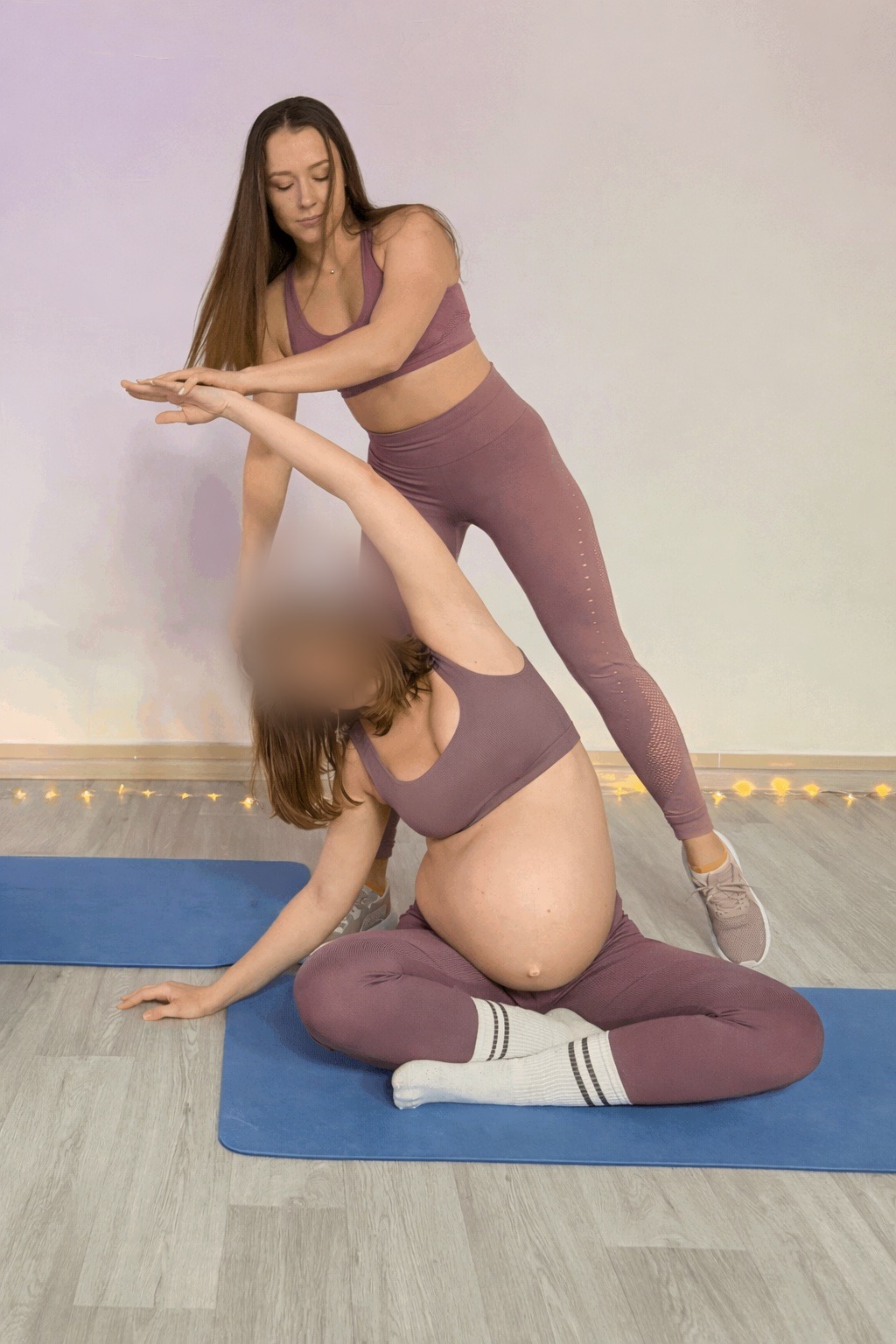
How to do it: sit upright, place your palms on the sides of the ribs. On the inhale direct the air into the sides – feel the ribs expanding outward, the palms moving apart. On the exhale the ribs gently come back together. Try not to lift the shoulders – the movement happens in the rib area, not in the upper chest.
Why it matters: rib breathing expands the breathing volume when the diaphragm cannot fully descend. It also mobilises the thoracic spine – an area that often becomes stiff during pregnancy due to postural changes.
When to use it: especially useful in the second and third trimester, when diaphragmatic breathing becomes less accessible.
Breathing with sound on the exhale
A technique that combines breathing work with preparation for birth.
How to do it: inhale through the nose, on the exhale softly make a long sound – “aaa”, “ooo”, or “uuu”. The sound is low and even. The exhale is roughly twice as long as the inhale.
Why it matters: a lengthened, voiced exhale activates the parasympathetic nervous system. In labour, the ability to relax on the exhale helps the cervix to open and conserves energy. The sound also prevents breath-holding – a typical mistake when in pain.
When to use it: can be started in the second trimester, but is especially relevant in the third – as part of preparation for birth.
Breathing with pelvic floor activation
This technique links breathing with the work of the pelvic floor and deep trunk muscles.
How to do it: on the inhale relax the pelvic floor – imagine it dropping like a hammock. On the exhale gently lift it up and inward. The movement is light, not a maximum squeeze.
Why it matters: the pelvic floor and the diaphragm form a single system. Coordinating them through the breath strengthens organ support, helps with incontinence, and prepares the body for birth.
When to use it: at any stage. This is one of the most important practices throughout pregnancy.
When and how long to practise
Breathing exercises do not require much time. Five to ten minutes a day is enough – and that already gives a noticeable effect. Here are some practical recommendations.
Morning. Start the day with two to three minutes of diaphragmatic breathing – this helps you wake up gently, set the breathing system in tune, and lower morning anxiety.
During the day. If you feel breathless, anxious, or tense – take a pause and breathe for one to two minutes with rib breathing. You can do it sitting at a desk, in transport, in a queue.
Evening. Before bed practise breathing with sound on the exhale – it relaxes the nervous system and helps you fall asleep. Three to five minutes is enough.
Before training. If you exercise regularly, include breathing in your warm-up. This helps the body shift into conscious movement.
Important: do not force the breath. If a technique causes dizziness, nausea, or discomfort – stop. Return to normal breathing and try again later. All techniques should be performed gently and comfortably.
The link between breathing, the pelvic floor, and the trunk
Breathing is not an isolated process. The diaphragm, the pelvic floor muscles, the transverse abdominis, and the spinal extensor muscles form a so-called “pressure cylinder” – a system that supports the spine and the internal organs.
When breathing works correctly, this whole system functions in harmony. When breathing is shallow, held, or uneven, the balance is disrupted, and the load shifts to other structures: the lower back, the joints, the pelvic floor.
This is why in training for pregnant women, breathing is not just a warm-up but the foundation of every exercise. We do not separate movement from breathing – we combine them into a single piece of work. This makes every exercise more effective and safer.
The same principle applies to cardio: for example, when discussing running during pregnancy, the first question is not “is it allowed or not?”, but “can you hold diaphragmatic breathing under load?”. If the breath shifts up to the upper chest – it is time to lower the pace.
You can read more about training in the third trimester, where breathing plays a key role, in the article on third trimester training.
Breathing and preparation for birth
Breathing techniques are one of the most accessible tools for preparing for birth. And it is not that “correct breathing relieves pain” – although that is also true. The main thing is that breathing gives you a point of control in a situation you cannot fully control.
During contractions, the ability to switch to a slow, deep exhale helps relax the muscles, lower adrenaline, and keep clarity of mind. Women who practised breathing techniques before labour describe this as an “anchor” – something to hold on to when everything around you is intense.
But the skill does not appear in one day. If you first try a breathing technique in labour itself, it will not work. The body and the mind need to get used to it, so switching to conscious breathing becomes automatic. That is why it makes sense to start in advance – ideally in the second trimester.
A general overview of the training approach to pregnancy is on the pregnancy page.
In summary
Breathing exercises are not an optional extra but a basic tool for supporting the body during pregnancy. They help adapt to changes, strengthen deep muscles, reduce anxiety, and prepare for birth. At the same time, they require no equipment, no special space, and only a few minutes a day.
Breath is also the base of prenatal yoga: if you want to add movement to the practice, start with safe poses by trimester.
If you want to understand the techniques in more detail and learn to apply them correctly, book an intro session. We will work through your specific needs and choose the breathing practices that suit your stage. The intro session costs from 1,400 rubles (online). Sessions are held in Samara in person and online.