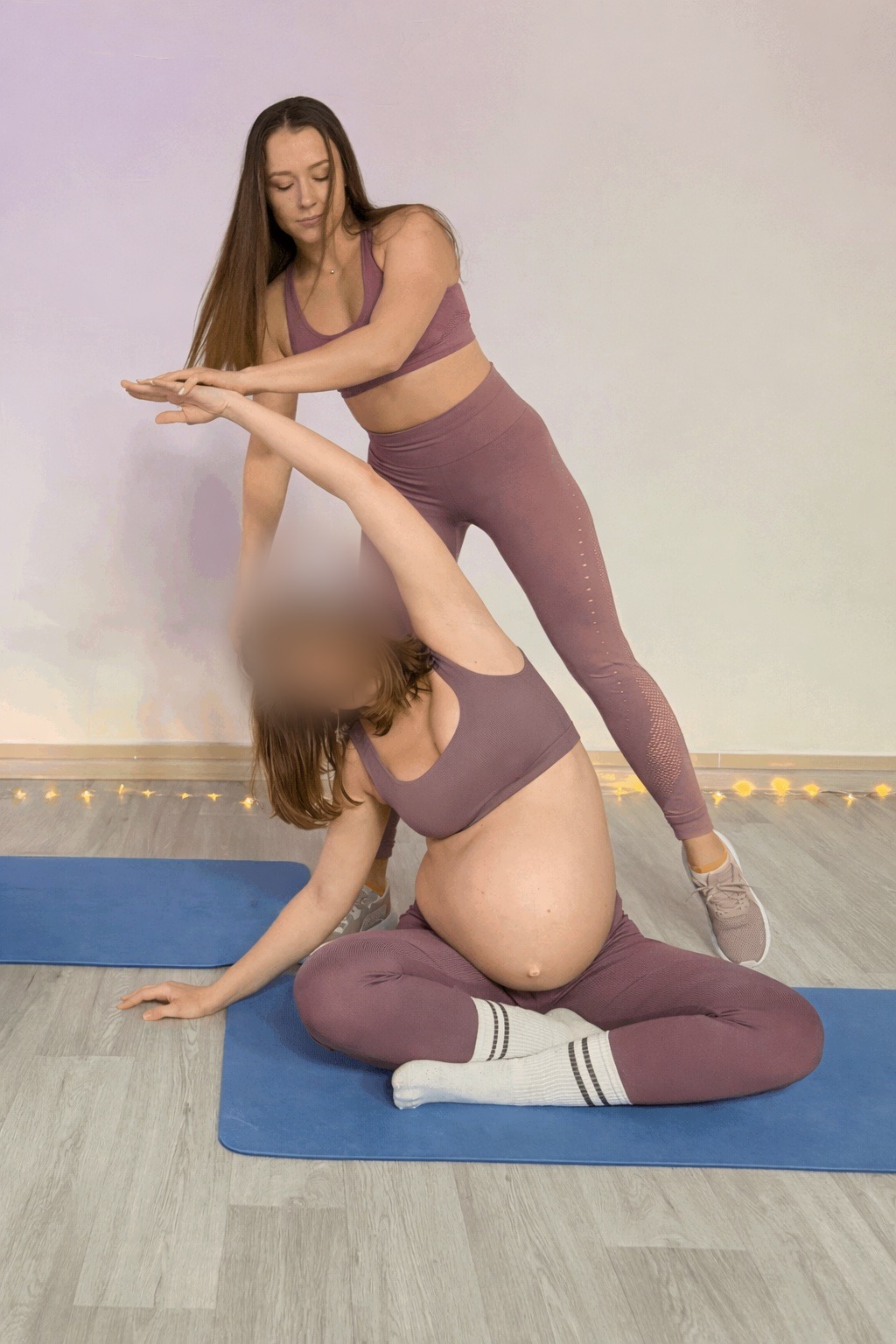
In short. Back or lower back pain affects 50-80% of pregnant women, usually starting in the second trimester. The main causes: a shift in the centre of gravity and growing lordosis (5-10° by week 16-18, 15-20° by week 36), the action of the hormone relaxin (from week 8-10 it softens the sacroiliac ligaments), a weak deep core, and disengaged glutes. What relieves it in 1 minute: standing up and 30-60 seconds of slow walking plus 5-7 cat-cow rounds on all fours. What relieves it within a week: glute bridges 2-3 sets of 10-15 reps every other day, diaphragmatic breathing 5 minutes morning and evening, side plank on the knee, a warm (not hot) shower on the lower back and sacrum in the evening. What makes it worse: crunches and abdominal work, heavy squats, wearing a support belt all the time, prolonged standing or sitting without breaks. See a doctor immediately if there is sharp one-sided pain, spotting, rhythmic pain, or girdle-like pain radiating to the groin.
Lower back pain during pregnancy affects 50-80% of expectant mothers. For most women it eases within 1-2 weeks of consistent work on the deep core and glutes – without pills and without medical pain relief.
Back pain or lower back pain: are they the same?
In everyday speech, “my back hurts during pregnancy” and “my lower back hurts during pregnancy” refer to the same area: the lower back above the sacrum. In medical terms, the “lower back” is a specific section of the spine (the lumbar vertebrae L1-L5), while “back” is a broader concept. Most “back pain” complaints in pregnant women are in fact lower back pain, and the solutions are the same.
If the pain is higher up, between the shoulder blades or in the upper back, that is the thoracic region, and the causes are different: a growing chest pulls the shoulders forward, sedentary work increases kyphosis, the chest muscles shorten. It is addressed through posture work and stretching of the chest, not lower back exercises.
This article focuses on lower back pain – the most common complaint during pregnancy.
Why the lower back hurts specifically during pregnancy
Lower back pain is one of the most common complaints during pregnancy. According to various data, between 50 and 80 percent of expectant mothers experience it. This is not a whim of the body, but a natural reaction to the serious changes that take place over nine months.
To understand what to do about this pain, it is important to understand where it comes from. There are several causes, and they usually work together.
The main causes of lower back pain in pregnant women
Shift in the centre of gravity. As the belly grows, your centre of gravity moves forward. The body compensates by increasing the curve in the lower back – the so-called lumbar lordosis. Back muscles start working in an unfamiliar way, become overloaded and tired. Hence the pulling, aching pain, especially towards the end of the day.
The hormone relaxin. During pregnancy the body produces the hormone relaxin, which makes ligaments and joints more mobile. This is necessary to prepare the pelvis for birth, but a side effect is instability in the lumbar spine and the sacroiliac joints. The joints become less “fixed”, and the muscles have to take on an additional stabilising role.
Weight gain. During pregnancy a woman gains on average from 10 to 15 kilograms. This extra load falls primarily on the lower back and pelvis. If the core and back muscles were not well prepared before pregnancy, discomfort can appear as early as the second trimester.
Changes in posture and habitual movement patterns. Pregnant women often unconsciously change the way they walk, sit, stand, bend. These new movement habits are not always optimal for the spine and can increase tension in the lower back.
Prolonged sitting and standing. Static postures are an enemy of the lower back at any time, but especially during pregnancy. If you sit a lot at work, or, conversely, stand for long periods, the lower back is one of the first areas to react.
What changes in the lower back month by month
To understand what measures work at which stage, it helps to refer to specific changes in the body. The numbers below are reference points from biomechanical literature and obstetric guides – they will differ for each individual woman, but the overall pattern is the same.
| Stage | What changes in the body | How it affects the lower back | What to focus on |
|---|---|---|---|
| 1st trimester (1-13 wk) | Relaxin is already rising, centre of gravity barely shifted, weight gain 1-3 kg | Pain comes more from fatigue and nausea than from mechanics. Tolerance for long static positions is already reduced | Prevention: strengthening the deep core and glutes, mobilising the spine, posture work |
| 2nd trimester (14-27 wk) | Belly becomes visible from weeks 16-18, lumbar lordosis grows by 5-10°, weight gain 4-8 kg | The lower back starts working in a new way, back muscles get overloaded. Daily lower back fatigue appears | Active posture work, pelvic tilts, decompression via mobilisation + glute support |
| 3rd trimester (28-40 wk) | Lordosis grows 15-20° from baseline, weight gain 9-15 kg, relaxin at peak, very active sacroiliac joint | Pain can be intense, sacrum and hip pain may be added. High risk of confusing with symphysis pain or labour onset | Minimise static positions, water-based work, gentle mobilisation, support belt during long activity |
The biggest shift happens in the second trimester – that is where targeted work with the back should begin, not “when it starts hurting more”.
The deep core: why it matters, not “training the abs”
The most common mistake when working with lower back pain in pregnant women is focusing on superficial muscles (the rectus abdominis, side bends). In reality, lower back pain in most cases is caused not by weak “abs”, but by uncoordinated work of the inner corset.
The inner corset – four layers of muscles working together:
- The diaphragm – the upper wall of the corset. Controls intra-abdominal pressure.
- The transverse abdominis – the front and side walls. Wraps the torso like a weightlifter’s belt from inside.
- The pelvic floor muscles – the lower wall. Support the organs and distribute pressure from above.
- The multifidus muscles of the back – the back wall. Stabilise each vertebra relative to its neighbour.
When these four layers work together, the lower back gets 360-degree support from inside. When the work is out of sync (for example, the diaphragm breathes “upward”, the pelvic floor is clenched, the transverse does not engage), the entire load falls on the lower back muscles and ligaments, and they fatigue within 2-3 hours of an active day.
This is why the foundational work in pregnancy is not “abdominal exercises” but breathing practices that synchronise all four layers. This is where almost every programme for lower back pain begins.
What is most often missed: the difference between “release” and “strengthen”
A common scenario – a woman arrives with lower back pain, is given a set of strengthening exercises for the back, and a week later the pain is worse. The reason is that the muscles in the lumbosacral region are already in constant tension (hypertonus), and they need release and mobilisation, not additional load. Strengthening only works after the hypertonus is eased.
Signs of lumbar muscle hypertonus:
- In the morning after waking, the lower back feels “wooden”, you need a few minutes to loosen up.
- When trying to bend forward from standing, there is a hard restriction in the lower back.
- On palpation, the lower back muscles are dense and tender.
- The pain increases at the same fixed point, it does not “wander”.
With hypertonus, the order is:
- Slow cat-cow (3-5 minutes).
- Child’s pose with knees apart (if the belly allows).
- Wall hangs or partial hangs – gentle traction.
- A warm shower on the lower back for 5-7 minutes.
- Only then – strengthening exercises for the deep core and glutes.
If, on the contrary, the lower back muscles are weak (no hypertonus, pain comes at the end of the day from fatigue), the priority is reversed – immediate strengthening of the glutes and deep core, and relief from static postures with short breaks.
What actually helps
The good news: in most cases, lower back pain during pregnancy can be significantly reduced. Not eliminated completely – the body keeps changing – but the discomfort can be brought down so it no longer interferes with normal life.
Movement. Probably the most important factor. Regular moderate physical activity – walking, swimming, specialised training for pregnant women – helps keep muscles toned and circulation good. Complete rest with lower back pain usually makes things worse, not better.
Stretching. Gentle stretching of the back, hip, and posterior thigh muscles can significantly ease symptoms. Forward bends from all fours, gentle seated torso rotations, and stretching the piriformis muscle are especially useful. The key is to move smoothly, without jerking and without pain.
Posture work. Simply becoming aware of how you sit and stand already has an effect. Try not to collapse into the lower back, use a pillow behind the lower back when sitting, keep the pelvis in a neutral position. You can read more about safe movement principles on the approach to training page.
Strengthening the deep muscles. The deep core muscles – the transverse abdominis, pelvic floor muscles, multifidus – act as an inner corset. When they work together, the load on the lower back is distributed more evenly. Activating these muscles through breathing and gentle exercises is one of the foundations of working with back pain in pregnancy.
Heat and a support belt. A warm (not hot) shower directed at the lower back can temporarily relieve muscular tension. A pregnancy support belt helps some women – it supports the belly and partially unloads the lower back. But a belt is not a substitute for muscular work, only an addition to it.
Which exercises are safe
During pregnancy, the appropriate exercises are those that gently strengthen the back and core muscles, improve mobility, and do not create excessive pressure on the belly.
Cat-cow. A classic exercise on all fours: on the inhale you gently arch your back down, on the exhale you round it up. Helps mobilise the spine and ease tension. Safe at any stage.
Pelvic tilts. Standing by a wall or on all fours, gently tuck the pelvis, reducing the curve in the lower back. This exercise strengthens the deep abdominal muscles and teaches pelvic control.
Gentle torso rotations. Sitting on a fitball or chair, smoothly rotate the torso to the right and left. This helps preserve thoracic mobility and reduce compensatory load on the lower back.
Glute bridge. Lying on the back with knees bent, lift the pelvis up and hold for a few seconds. Strengthens the glutes, which directly affect the state of the lower back. After 20 weeks it is better to perform it with the upper body propped up or replace it with a standing variation.
Swimming and walking. Not exercises in the classical sense, but the best friends of the lower back during pregnancy. Water removes axial load, walking supports muscle tone without overloading.
A key principle: any exercise should be comfortable. If you feel pain, pressure in the lower abdomen, or dizziness – stop. Discomfort is a signal, not something to push through.
Decision tree: what relieves the pain in 1 minute, 5 minutes, 1 week
Pregnant women often either do nothing and endure, or try to solve everything with a single workout. Between these two extremes there is a simple time-based scale.
If it hurts right now (1 minute):
- Stand up, walk slowly for 30-60 seconds.
- If that does not help, go onto all fours and gently arch (cow) and round (cat) the spine 5-7 times.
- If that does not help, lie on the left side with a pillow between the knees and do diaphragmatic breathing for 1-2 minutes.
If it hurts regularly by the end of the day (5 minutes morning and evening):
- In the morning after waking – 5 minutes of diaphragmatic breathing, 5 cat-cow rounds on all fours, 10 pelvic tilts lying down.
- Every 30-40 minutes at work – stand up, walk for 1-2 minutes.
- In the evening – a warm (not hot) shower on the lower back and sacrum for 5 minutes plus a stretch of the front of the thigh, 30 seconds per side.
If you want to remove the cause (1 week of consistent work):
- Glute bridges, 2-3 sets of 10-15 reps every other day – the glutes are the main antagonist of lordosis, and when they work the lower back is automatically unloaded.
- Deep core: “bird-dog” and side plank on the knee, 3 times a week.
- Walking, 30 minutes daily (can be split into two 15-minute walks).
- Sleep on the left side with a pillow between the knees.
In my practice, most clients who follow this scheme report 2-3 times less pain within 1-2 weeks of regular work, and within 4 weeks the pain is gone (if there is no separate pathology).
A case from practice
A client came to me at 26 weeks of her first pregnancy with the complaint “my back has been hurting for a month and nothing helps”. We clarified: it was the lower back, by the evening, after 4-5 hours of sedentary work. A support belt did not help, and she was afraid to take painkillers. The programme turned out simple: every 40 minutes – 1 minute of walking down the corridor; in the morning and evening for 5 minutes – diaphragmatic breathing, cat-cow, pelvic tilts; every other day, a 15-minute set of glute bridges, side plank on the knee, and side-lying leg abductions. After 10 days of consistent work the pain eased within the first minute of walking and no longer returned by the evening. By week 30 it came back, but at only 1-2 out of 10 – which is normal for a growing belly.
The main takeaway: lower back pain in pregnant women is not “endure it until birth”. It is a signal that the deep core and glutes are not coping with compensation, and it can be almost entirely removed without pills, within 1-2 weeks of work.
When you need to see a doctor
In most cases, lower back pain during pregnancy is a normal sign of bodily adaptation. But there are situations when you need to see a specialist.
Red flags – see a doctor as soon as possible:
- The pain is accompanied by spotting
- You feel regular rhythmic pains that could be contractions
- The pain radiates into the leg, with numbness or weakness
- A sharp, sudden pain appears that does not go away when you change position
- The pain is accompanied by fever or painful urination
- The pain becomes so strong that it interferes with sleep and movement despite all measures
Separately: if the pain appears suddenly, sharply intensifies, or changes in character – do not delay the visit to the doctor. Better to be cautious than to miss something important.
What not to do
A few common mistakes that can make things worse:
- Strict bed rest without medical indication. Rest is good, but prolonged lying down weakens muscles and intensifies pain.
- Trying to “loosen up” the back with sharp movements or with the help of an unqualified massage therapist.
- Wearing high heels – they increase lumbar lordosis and instability.
- Lifting weights with a rounded back. If you need to lift something, squat down rather than bending over.
- Ignoring the pain on the principle “this is normal, I have to endure”. You should not endure it – you should act.
In summary
Lower back pain during pregnancy is not a verdict and not something you must simply put up with. Yes, it is hard to avoid discomfort completely, but a thoughtful approach to movement, posture, and strengthening of deep muscles can make the difference between “tolerable” and “I am moving normally again”.
The most effective thing you can do is not wait until the pain becomes severe, but start working with your body now. Regular gentle activity, attention to posture during the day, and adequate strengthening of the deep muscles give a cumulative effect.
If you are unsure which exercises suit you and how to perform them correctly – come to the intro session. We will choose exercises that take into account your stage, wellbeing, and individual features. Book the intro session here.
If your work is sedentary and the pain appears specifically by the end of the workday – a separate guide on exercises for pregnant women at work covers a warm-up right at the desk and chair adjustment. And if you want to see how the load changes from trimester to trimester, that is in pregnancy fitness by trimester.
This topic is also covered in my blog on T-Zh (in Russian): How posture changes in each trimester of pregnancy.