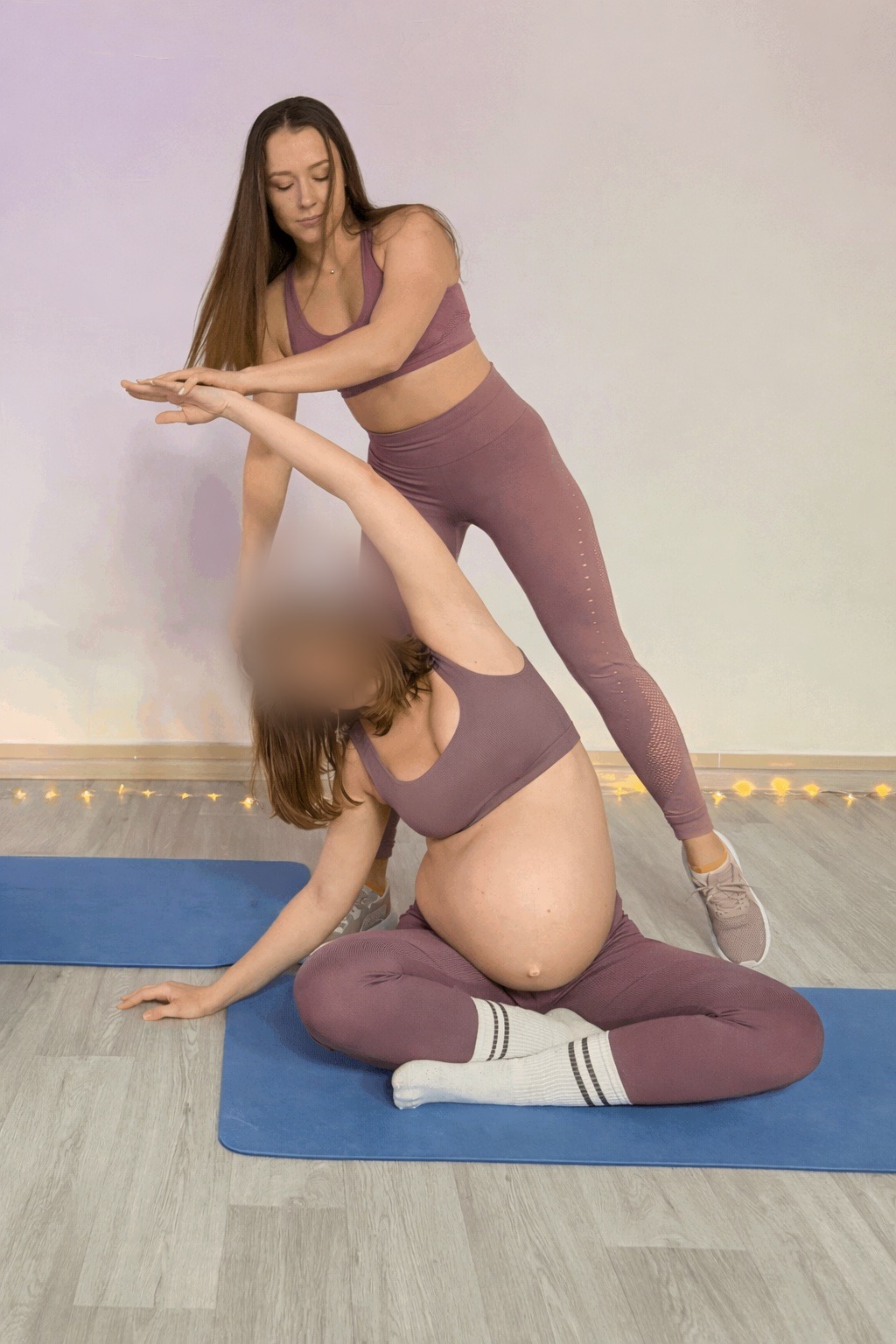
In short. Physical preparation of the body for birth is work with four systems: the pelvic floor (strength and elasticity via the exhale), diaphragmatic breathing (the base for managing contractions), pelvic mobility (butterfly, pelvic circles, deep squat), and overall endurance (walking 30-40 minutes a day, swimming). The ideal start is the second trimester (14-27 weeks), but there is still an effect when starting at weeks 28-30. The programme changes by week: 14-22 wk – building the foundation, 22-28 wk – peak of active preparation, 28-34 wk – lowering strength work and focusing on breathing, 34-38 wk – pelvic mobilisation and self-massage of the perineum, 38-40 wk – only relaxation and walking. According to current clinical guidelines, 150 minutes of moderate load a week in an uncomplicated pregnancy lower the risk of gestational diabetes by 30-40%, pre-eclampsia by 20-30%, shorten labour, and speed up recovery. Consistency matters more than intensity: 15-20 minutes a day delivers a result a one-hour intensive once a week cannot.
The phrase “preparing for birth” is often associated with antenatal classes that cover the stages of labour, breathing, and how to behave at the maternity hospital. All of that is useful, but there is another important aspect – physical preparation of the body. Birth is serious physical work, and a body that is ready for it goes through the process more easily.
According to current clinical guidelines, 150 minutes of moderate physical activity per week in an uncomplicated pregnancy lower the risk of gestational diabetes by 30-40%, pre-eclampsia by 20-30%, shorten labour, and reduce recovery time afterwards.
Preparation does not mean exhausting workouts or sporting feats. It is calm, purposeful work with the systems directly involved in birth: the pelvic floor, breathing, hip mobility, and overall endurance. In this article we go through each area, specific exercises, and the optimal timing to start.
What it means to “prepare the body” for birth
When we talk about physical preparation for birth, we are talking about several specific tasks.
The pelvic floor must be both strong and elastic. The pelvic floor muscles support the uterus, bladder, and rectum. During birth they first have to withstand the pressure of the baby’s head, and then stretch enough to let it through. A pelvic floor that is too weak does not handle the support, and one that is too tight does not handle the stretch. You need a balance.
Breathing must work effectively. The ability to manage breathing helps you relax during contractions, conserve energy, and maintain oxygen supply for yourself and the baby. This is not just “breathe deeply” – these are specific skills built up through practice.
The hip joints must be mobile. Pelvic and hip mobility affects how comfortably the body can take positions optimal for birth. Stiff, restricted joints create extra tension and discomfort.
Overall endurance must be sufficient. Birth can last for hours. It is a marathon, not a sprint. A body used to regular load handles prolonged effort – physical and emotional – better.
When to start
The ideal time is the second trimester (14-27 weeks): nausea is gone, energy is higher, the body is still mobile. But if you did not start on time – start in the third trimester. The main things are a gentle, gradual entry and clearance from the doctor.
A map of preparation by week
Pregnancy is not one long stretch but several different phases with different priorities. Here is what makes sense to do in each phase.
| Stage | Main focus | What to add |
|---|---|---|
| 14-22 weeks | Building the foundation | Diaphragmatic breathing 5 minutes morning and evening. Basic pelvic floor activation (10 reps × 2 times a day). Strength training 2-3 times a week for 30 minutes. Walking 30-40 minutes daily. |
| 22-28 weeks | Peak of active preparation | Add pelvic mobility (pelvic circles, butterfly pose). Learn to relax the pelvic floor on the inhale (this is harder than squeezing). Strength training 2 times a week with light weights. |
| 28-34 weeks | Reducing strength work, focus on preparation | Strength work tapers off. Increase breathing with sound (“aaa” / “ooo” on an extended exhale). Butterfly pose 5 minutes a day. Walking continues. Add “labour positions” (deep squat with support, all-fours pose). |
| 34-38 weeks | Final mobilisation | Daily breathing. Pelvic circles on a fitball 5 minutes morning and evening. Stretching the front of the thigh, glutes, and lower back. Self-massage of the perineum with warm oil (with the doctor’s clearance) – reduces the risk of tearing in labour. |
| 38-40 weeks | Relaxation and waiting | Only breathing, releasing neck, shoulders, jaw, gentle walking. No new exercises. Imitating breathing during contractions. Sleep on the side with a pillow between the knees. |
If the pregnancy is high risk or there are contraindications, the table does not apply – the programme is built individually with the doctor.
The pelvic floor: the foundation of preparation
The pelvic floor is a group of muscles that closes the bottom of the pelvis. During pregnancy these muscles take an increased load: the growing weight of the uterus presses down from above. During birth the pelvic floor needs to stretch to let the baby through, and afterwards – to recover.
Pelvic floor exercises
Basic activation. Sit comfortably or lie on your side. Pull the muscles around the vagina and anus up and inward. Hold for three to five seconds, then release. Repeat ten times. After each contraction – full relaxation: that is just as important as the contraction itself.
Quick contractions. Quickly squeeze and release the pelvic floor muscles – without a pause, one after another. Ten reps. Trains the muscles’ quick response.
Relaxing the pelvic floor. On the inhale, direct the breath downward and imagine the pelvic floor releasing. On the exhale, gently draw it up. This teaches the muscles to be not just strong but elastic – critically important for birth.
Coordination with breathing. Inhale – release. Exhale – draw up. This is the skill that will be useful in labour: the ability to relax the pelvic floor on the exhale when the body wants to clench.
More about pelvic floor work – in the article on Kegel exercises during pregnancy.
Breathing: more than just “breathing”
Breathing techniques are the second key element of preparation. They help at all stages of labour.
During contractions – a deep exhale with sound relaxes the muscles and supports cervical dilation. Between contractions – diaphragmatic breathing restores energy. During pushing – coordinating breath with effort allows you to push effectively.
What to practise
- Diaphragmatic breathing – the basic technique that brings breathing back from the upper chest into the belly.
- Extended exhale with sound – inhale for four counts, exhale for six to eight counts with a soft “aaa” or “ooo”. Trains exhale-based relaxation.
- Rib breathing – directing air to the lateral and posterior parts of the ribs. Useful in the third trimester, when diaphragmatic breathing is limited.
More about all techniques – in the article on breathing exercises for pregnancy.
Hip mobility
The hip joints play a key role during birth. Their mobility affects how freely you can move, change positions, and find a comfortable position.
Mobility exercises
Pelvic circles. Stand with feet shoulder-width apart, hands on hips. Slowly perform pelvic circles – as if drawing a large circle. Ten times in one direction, ten in the other. Can be done standing or sitting on a fitball. This mobilises the hip joints and eases tension in the lower back.
Butterfly pose. Sit on the floor, bring the soles together, knees pointing outward. Spine straight, do not slump backwards. Gently rock the knees up and down like butterfly wings. Do not press the knees down with your hands – the movement should come from the muscles. This pose gently opens the hip joints and stretches the inner thighs.
Deep squat with support. Stand facing a wall or chair, feet wider than the shoulders, toes turned out. Lower into a deep squat, holding the support. Hold for five to ten seconds. The deep squat is one of the most physiological positions for birth.
Kneeling lunge. Kneel on one knee, the other foot in front. Gently shift the pelvis forward, feeling a stretch in the front of the thigh. Hold for ten to fifteen seconds. Stretches the iliopsoas muscle, which shortens with sedentary lifestyle.
Overall endurance
Birth is a multi-hour process that requires physical and mental endurance. A body used to regular load handles it better.
For endurance you do not need intense cardio. Regular gentle movement is enough.
Walking – thirty minutes a day at a comfortable pace. The pace should let you talk without breathlessness.
Swimming – an excellent option for late pregnancy. Water unloads the joints, and movement trains breathing and endurance.
Bodyweight training – squats with support, calf raises, gentle lunges at a calm pace.
Checklist for the final 6 / 4 / 2 weeks before the due date
The final weeks are not about “maintaining form” but about specific preparation. The programme becomes shorter and calmer, the emphasis shifts.
6 weeks to the due date – the load-reduction phase
From week 34 we remove everything “to failure”, heavy squats, and exercises that leave you breathless. The programme is shorter (20-30 minutes) and calmer. The main parts:
- diaphragmatic breathing 5 minutes morning and evening
- cat-cow and pelvic tilts for lower back mobility
- walking 30-40 minutes a day at a comfortable pace
- stretching the front of the thigh and the thoracic spine
4 weeks to the due date – the pelvic mobilisation phase
The goal is a maximally mobile pelvis, relaxed hips, and a flexible lower back. What we add:
- Butterfly pose on the floor 5 minutes a day, gently pressing the knees with the elbows.
- Wall squats with a 30-60 second hold (back pressed against the wall) – strengthen the legs and at the same time open the pelvis.
- A large inflatable ball (fitball) – pelvic circles and figure eights. 5 minutes morning and evening.
- Lying glute stretch: one leg bent, ankle on the knee of the other leg, gently pulling towards the chest.
Strength work in this phase is gentle only, without “failure”, twice a week for 20 minutes.
2 weeks to the due date – final preparation
Strength work goes away completely. What remains:
- diaphragmatic breathing and imitation of birth breathing (inhale for 4 counts, exhale for 6-8 counts through resistance with the lips, “fffff”)
- cat-cow, pelvic tilts
- a long walk
- releasing the neck, shoulders, and jaw – these are exactly the zones that clench during contractions, and how quickly the cervix opens depends on releasing them
- self-massage of the perineum with warm (unscented) oil – discuss with the doctor, reduces the risk of tearing in labour
Decision tree: which positions to try in labour
Which position is “yours” depends on mobility and preference. A simple algorithm:
-
Can you calmly squat all the way down into a deep squat without support?
- Yes: the deep squat is your “own” position. Master it before birth, practise for 30 seconds.
- No: go to step 2.
-
Are you comfortable on all fours with the “cat-cow” arch?
- Yes: all fours plus pelvic rocking is your “own” position. Can be reinforced with support on a fitball.
- No: step 3.
-
Can you lean on a wall or partner and gently step from one foot to the other?
- Yes: standing with support is “your own”. Combines best with rocking.
- No: go to step 4.
-
Are you comfortable lying on the left side with a pillow between the knees?
- Yes: side-lying is your “own” position. Excellent when tired and for rest between contractions.
Ideally by birth you have 2-3 “own” positions. In labour the one that works best in the moment is used.
The focus of the third trimester
From week twenty-eight the emphasis shifts. If in the second trimester you could work on strength and endurance more actively, in the third the main thing is preparation directly for birth.
Breathing practices come to the foreground. Daily practice of relaxation-oriented breathing with sound, coordinated breath and pelvic floor – this is what will work in labour.
Birth positions. Practise the deep squat, the all-fours pose, leaning forward with support – so that in birth these positions feel familiar.
Relaxation. The ability to relax the pelvic floor, jaw, and shoulders on the exhale – a counterweight to the tension of pain.
Gentle mobility. Pelvic circles on a fitball, butterfly pose, gentle bends.
What to avoid
For all the usefulness of exercise, there are things to skip.
- Do not lie on your back after week twenty – the uterus may compress the inferior vena cava.
- Do not hold your breath under effort – it loads the pelvic floor.
- Do not train through pain – pain is always a signal to stop.
- Do not start intense activities – pregnancy is not the time for experiments.
- Do not train without clearance from the doctor.
What clinical guidelines say
Current obstetric standards agree: in an uncomplicated pregnancy regular physical activity is safe and recommended. The current consensus includes pregnant women in the standards for physical activity: 150 minutes of moderate load a week plus strength work twice a week. Moderate physical load reduces the risk of gestational diabetes by 30-40%, pre-eclampsia by 20-30%, shortens labour, and reduces recovery time.
The key phrase is “in an uncomplicated pregnancy”. This does not mean “when it does not feel scary”. It means: when there are no specific contraindications (placenta praevia, threatened miscarriage, cervical insufficiency, pre-eclampsia, bleeding, multiple pregnancy with risk of preterm labour, and so on). Any programme of preparation for birth goes through the obstetrician’s clearance.
A case from practice
Last year a client came to me at 28 weeks of her first pregnancy – she had done none of the preparation up to that point and was worried. The plan: the first week – only learning diaphragmatic breathing (5 minutes morning and evening) and daily walking for 30 minutes. From the second week we added basic pelvic floor activation (10×2 a day) and pelvic circles on a fitball. From week 32 – butterfly pose and wall squats. From week 34 – breathing with sound, imitation of birth breathing, all-fours pose. From week 38 – only relaxation and walking.
In labour she used the all-fours position and rocking on the fitball. Dilation took 5 hours, the pushing stage was short, with no tearing. Her comment: “Without preparation I would not have known which position to move to, and would have just lain on my back”.
The main takeaway: even 8-10 weeks of regular work for 15-20 minutes a day give a result. Starting late is better than not starting at all.
In summary
Preparing the body for birth is not a maximum programme, but a reasonable minimum that significantly affects how your body goes through the process. The pelvic floor, breathing, mobility, and endurance – four areas you can purposefully train during pregnancy, each of them directly linked to birth.
You can start at any point, but ideally – from the second trimester. Even ten to fifteen minutes a day matter if the work is organised properly.
If you want a programme tailored to you – taking your stage, state, and goals into account – book the intro session. We will assess your current form, discuss your needs, and put together a preparation plan. The intro session costs from 1,400 rubles (online). I work in Samara in person and online. More about training for pregnant women – on the pregnancy page.
This topic is also covered in my blog on T-Zh (in Russian): How to prepare the body for birth: clinical guidelines and my practice as a trainer.