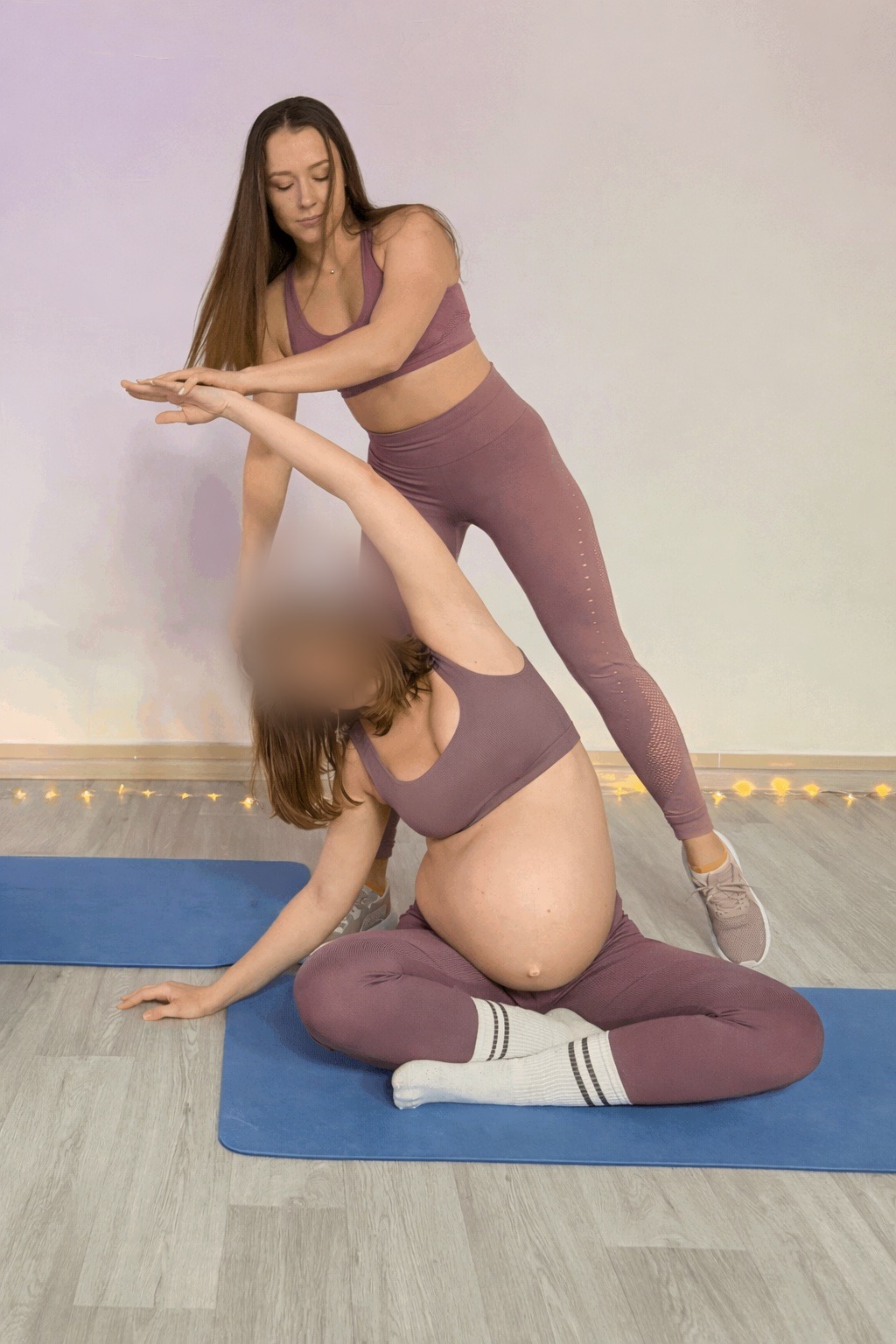
In short. During pregnancy six categories of load are excluded: contact sports (risk of a blow to the belly), exercises lying on the back after week 20 (aortocaval compression), jumping and high-impact loads (pressure on the pelvic floor, fall risk because of relaxin), heavy strength work with breath-holding (the Valsalva manoeuvre), hot yoga and saunas above 39°C (foetal overheating), activities with a fall risk – downhill skiing, horse riding, off-road cycling. Running is a grey zone: possible for experienced runners in the first trimester, switching to walking after weeks 20-24. All other movements are adapted to the stage, not banned: wall squats, resistance band rows, bridge with elevated support, swimming, walking, the stationary bike are available throughout pregnancy. Absolute prohibitions apply only with threatened miscarriage, placenta praevia, cervical insufficiency, or pre-eclampsia.
Aortocaval compression after week 20 is neither rare nor a myth: lying on the back for more than 3-5 minutes can lower blood pressure and reduce blood flow to the foetus, even if the mother does not feel dizzy.
Why a clear list of restrictions matters
When you find out you are pregnant, the first question about physical activity usually sounds like this: “Am I allowed to exercise at all now?” The answer is – yes, you can and you should. But with caveats it is important to know in advance, not to discover through trial and error.
The problem is that information online is often contradictory. Some sources scare you – “you can do nothing in pregnancy”, others, on the contrary, showcase pregnant athletes still lifting a barbell on the last day. The truth, as usual, is somewhere in between – but it requires specifics.
This article is a complete list of exercise categories to avoid during pregnancy, with the risks explained for each and safe alternatives. This is not fear-mongering – it is a tool for informed decisions.
Contact and team sports
What this includes: football, basketball, volleyball, hockey, martial arts, boxing, rugby, water polo.
Why to avoid: the risk of a direct blow to the belly. In early pregnancy the uterus is protected by the pelvic bones, but already in the second trimester it rises higher and becomes vulnerable. A ball strike, a collision with another player, an accidental shove – all of these create a risk of injury, placental abruption, and preterm labour.
Safe alternative: walking, swimming, stationary bike (not a road bike – that has its own risks), individual sessions with a trainer.
Lying on the back after week 20
What this includes: any exercises in a supine position that last longer than a few minutes – crunches, bench press, stretching, bridge, dead bug in its classic variant.
Why to avoid: in the second and third trimester the enlarged uterus can compress the inferior vena cava – the large vessel that returns blood to the heart. This leads to lower blood pressure, dizziness, nausea, and in some cases reduced blood flow to the foetus. The syndrome is called aortocaval compression.
Not all women feel symptoms, and that is exactly why the rule is formulated as a general restriction – you should not wait for dizziness to change position.
Safe alternative: exercises on the side, on all fours, sitting, standing. For example, instead of the classic bridge – a side bridge. Instead of lying crunches – core activation on all fours with breathing.
Jumping and impact loads
What this includes: running (especially intense), jumping rope, jump lunges, burpees, box jumps, plyometrics, trampoline jumping.
Why to avoid: several reasons at once. First, under the action of the hormone relaxin ligaments and joints become less stable – the risk of injury on landing rises significantly. Second, impact loads create pressure on the pelvic floor, which is already under additional load from the weight of the uterus. Third, balance during pregnancy is impaired by the shifted centre of gravity – the fall risk is real.
A separate note on running: it is not categorically forbidden in the first trimester for those who ran before pregnancy. But as the term grows, the load on the pelvic floor and joints becomes excessive, and most specialists recommend switching to walking. More details in the article «Can I run during pregnancy».
Safe alternative: walking (including brisk walking), swimming, elliptical, stationary bike, step platform without jumps.
Heavy strength training
What this includes: exercises with maximal or sub-maximal weight, work in the 1-3 rep range, heavy deadlifts, heavy squats, standing press with maximum effort.
Why to avoid: lifting a heavy weight almost inevitably comes with breath-holding and bearing down – the so-called Valsalva manoeuvre. It sharply raises intra-abdominal pressure, which loads the pelvic floor and any diastasis. Besides, with heavy weight technique can break down, and joints that are unstable from relaxin make this especially dangerous.
Important: strength training is not banned in pregnancy. Heavy strength training is banned. Working with moderate weights, where you can breathe freely and control technique, is allowed and useful. The benchmark is a weight you can lift for 12-15 reps while keeping breath and control.
Safe alternative: strength training with moderate weights, exercises with resistance bands and bodyweight, controlled squats, rows, and presses within a comfortable range.
Exercises with breath-holding and bearing down
What this includes: the Valsalva manoeuvre when lifting heavy weights, prolonged breath retention in yoga (kumbhaka), exercises in which you instinctively hold your breath from effort.
Why to avoid: holding the breath raises intra-abdominal pressure. In pregnancy this pressure is transferred to the already loaded pelvic floor, and in the presence of diastasis it pushes the abdominal contents through the gap between the muscles. Holding the breath can also cause a spike in blood pressure and dizziness.
A simple rule: if you cannot breathe calmly during an exercise, the load is too high.
Safe alternative: all the same exercises, but with less effort and with emphasis on exhaling at the moment of load. Breathe – this is not just a recommendation, it is the key to safety.
Hot yoga and training in hot environments
What this includes: Bikram yoga (40°C room temperature), hot Pilates, training in poorly ventilated halls, intense outdoor sessions in the heat.
Why to avoid: overheating – hyperthermia – is especially dangerous in the first trimester, when the main organs and systems of the foetus are forming. Research shows a link between elevated maternal body temperature and the risk of neural tube defects. But even later in pregnancy overheating is undesirable: it leads to dehydration, blood pressure spikes, and a general decline in wellbeing.
Safe alternative: ordinary yoga in a room at a comfortable temperature, Pilates, stretching. If you exercise outdoors in warm weather, choose morning or evening hours, drink enough water, wear light clothes, and do not push yourself to the point where “your face is burning”.
Exercises with a risk of falling
What this includes: skiing, snowboarding, horse riding, rock climbing, rollerblading and ice skating, road cycling, surfing, exercises on unstable platforms (Bosu, balance board).
Why to avoid: as the belly grows, the centre of gravity shifts forward and upward, and the joints become less stable. This significantly increases the risk of losing balance and falling. A fall on the belly can lead to placental injury, preterm labour, and other complications.
Even if you skied perfectly or stood confidently on a balance board before pregnancy – your body is working differently now. Reactions are slower, coordination has changed, and the consequences of a fall have become incomparably more serious.
Safe alternative: a stationary bike instead of a road bike, swimming instead of surfing, walking on a level surface instead of mountain trails. Strength exercises – with support or against a wall.
Deep crunches and intensive ab work
What this includes: classic crunches, Russian twists, lying leg raises, “bicycle”, V-ups, planks with long holds (especially from the second trimester).
Why to avoid: all these exercises create significant intra-abdominal pressure and load on the rectus abdominis muscles, which naturally separate during pregnancy. Intensive work can worsen diastasis and create excessive pressure on the uterus.
Crunches with torso rotation additionally compress the space for the baby, which is undesirable, especially as the term grows.
Safe alternative: activating the transverse abdominis through breathing, the cat-cow exercise, an adapted “dead bug” (without the supine position after week 20), a plank on all fours with short holds.
Scuba diving
What this includes: scuba dives at any depth.
Why to avoid: during ascent from depth, gas bubbles form in the blood. In adults they are eliminated through the lungs, but the foetal circulatory system cannot handle this process – there is a risk of gas embolism and tissue damage. This is one of the few absolute contraindications that applies throughout pregnancy.
Safe alternative: swimming and snorkelling (surface diving with a mask) are considered safe.
How to navigate: general principles
It is hard to remember every specific exercise, but you can rely on general signs. You should avoid any exercise that causes at least one of the following:
- Breath-holding or bearing down
- A feeling of downward pressure on the pelvic floor
- Pain or discomfort in the belly, back, or pelvis
- Your belly turns hard during or after an exercise and does not ease within 10–20 minutes of rest – how to tell this from normal, see uterine tone during pregnancy
- A “dome” – a ridge along the centre of the belly
- Dizziness or nausea
- A heart rate so high you cannot talk
- A sense of instability or risk of falling
If in doubt – do not do it. Removing an exercise and replacing it with a safe analogue is always the right strategy.
How to train safely
Restrictions are not a verdict. A huge number of exercises remain available throughout pregnancy: walking, swimming, strength training with moderate weights, adapted yoga, breathing and pelvic floor work.
The key is an individual approach. At the intro session we go through your situation: stage, wellbeing, training experience, restrictions. Based on that we select exercises that are safe and useful for you specifically. The intro session costs from 1,400 rubles (online). I work in Samara and online.
More about training during pregnancy is on the «Pregnancy» page. About the approach to safety – in the article «Can I run during pregnancy».