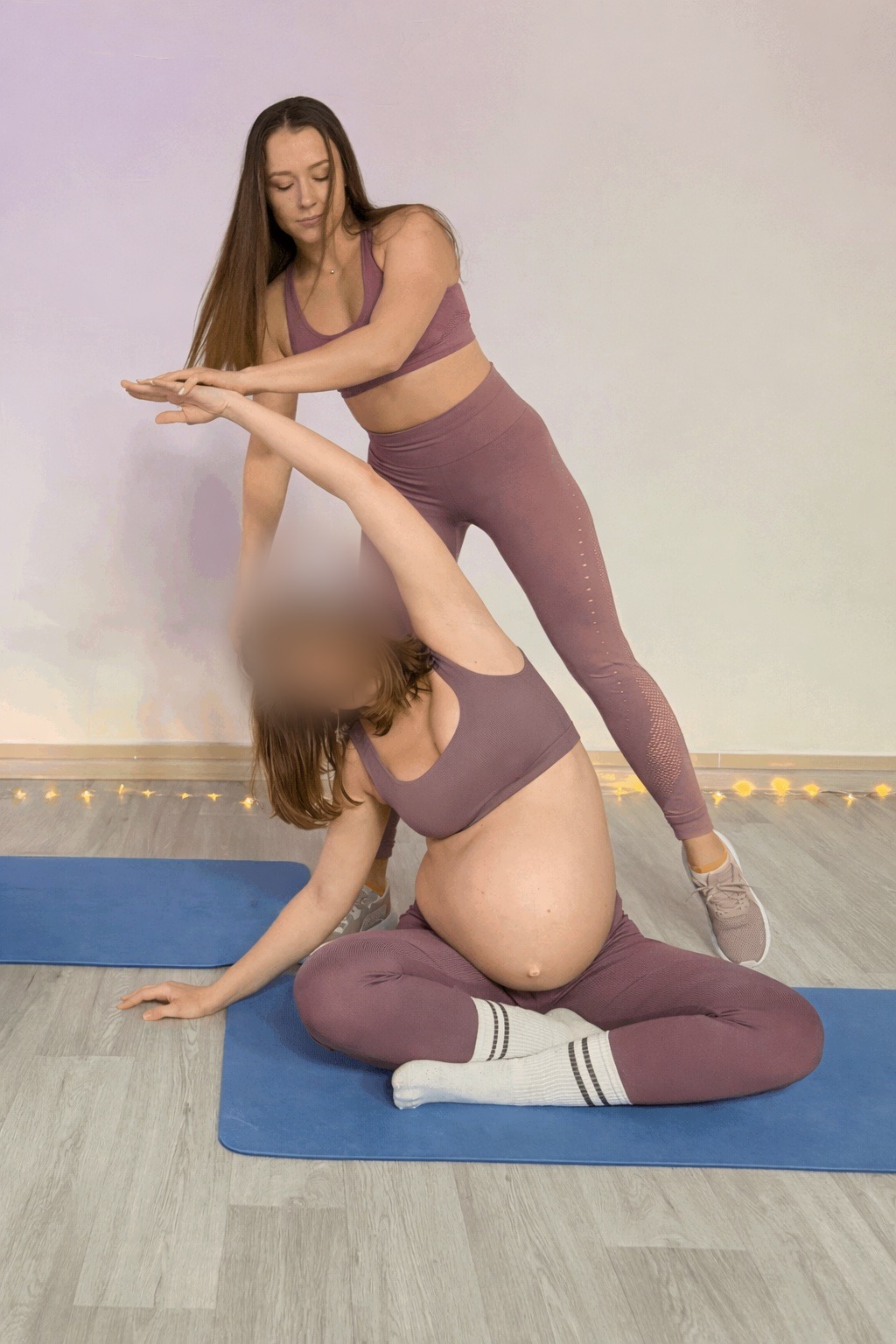
Can pregnant women practise yoga?
This question comes from almost every second client. Short answer: yes, but not any kind. The safe option during pregnancy is prenatal yoga – an adapted version with dangerous postures removed and an emphasis on breath, pelvic floor, and mobility. Classic hatha or ashtanga, which suit non-pregnant people, can be harmful during pregnancy.
In this article I will go through what is okay and what is not by trimester, how prenatal yoga differs from regular yoga, and how to practise at home safely.
Why regular yoga does not suit pregnant women
Three key changes during pregnancy rewrite the rules of yoga:
- Relaxin softens ligaments. The hormone that prepares the pelvis for birth softens all ligaments in the body. Deep stretches that carried no risk of overstretching before pregnancy can now cause injury.
- The linea alba stretches. By the third trimester most women have a functional diastasis. Deep twists and back bends put excess pressure on it and maintain the separation.
- Intra-abdominal pressure is higher. The growing uterus, on top of the already raised abdominal pressure, creates load on the pelvic floor. Any posture with abdominal tension or breath-holding (like a Valsalva in strength work) raises this pressure further and can weaken the pelvic floor.
The logic that follows is simple: yoga during pregnancy should lower pressure, not raise it. Stretch ligaments gently, not to the edge. Twist – only softly, and to one side, through the thoracic spine, not through the belly.
Safe asanas by trimester
First trimester (1–13 weeks)
In the first weeks most women feel fatigue and nausea – intense practice is often physically impossible. That is normal. Right now what matters more is breath and gentle mobility.
- Diaphragmatic breathing lying on the side or seated – 5–10 minutes a day. The link between diaphragm and pelvic floor.
- Cat-cow on all fours. No deep arch. Soft rounding of the back on the exhale, return to neutral on the inhale.
- Child’s pose with knees wider than hips (belly soft between thighs).
- Sukhasana (easy seat) with a gentle forward fold – hip opening.
- Tadasana (mountain pose) with attention to posture and breath.
What to skip for now: deep twists, jumps in vinyasas, inversions, asanas on the belly.
Second trimester (14–27 weeks)
The most comfortable trimester for most women. Nausea has passed, the belly is not yet large, energy has returned. You can expand the practice – but through variety, not intensity.
- Trikonasana (triangle pose) – with a wide stance and a hand supported on a block or shin. Opens the chest and works on pelvic mobility.
- Virabhadrasana 1 and 2 (warrior pose) – strengthens legs and glutes, opens the thoracic spine. No twisting of the pelvis, torso in the frontal plane.
- Utkatasana (chair pose) with the back supported on a wall – strengthens glutes and quadriceps, prepares for labour.
- Malasana (deep squat) with a block under the pelvis – one of the most useful asanas for labour preparation. Opens the pelvis and relaxes the pelvic floor.
- Side plank on the knee – core stability without abdominal pressure.
- Baddha konasana (butterfly pose) – gentle hip opening.
- Twists only through the thoracic spine (such as a seated bharadvaja) – no rotation through the belly.
After 16–18 weeks: do not lie on your back for more than 1–2 minutes. The growing uterus can compress the inferior vena cava, which reduces blood flow to the placenta and causes dizziness in the mother. Replace savasana with side-lying (left side ideally) with a pillow between the knees.
Third trimester (28–40 weeks)
In the third trimester the main job is preparing for labour, not “keeping form”. The practice becomes shorter and calmer.
- Malasana with support – continues; this is a working position for labour.
- Child’s pose with wide knees – relaxes the whole back line and the lower back, which often aches in the third trimester.
- Cat-cow – without arching, pelvic mobility.
- Breathing with a long exhale – a skill for the first stage of labour. Inhale for 4, exhale for 6–8.
- Reverse Kegel – pelvic floor relaxation on the exhale. The key skill for a safe pushing stage.
- Symmetric standing poses at the wall – tadasana with support, light squats at the wall.
What to skip in the third trimester: deep squats without support, lunges with weight transfer (unstable pelvis due to relaxin), long standing practices (oedema, varicose veins), any asanas lying on the back, any asanas on the belly.
What is definitely off the table in any trimester
- Deep twists in either direction. Through the thoracic spine gently – yes; through the belly – never. A twist compresses the uterus and maintains diastasis. This includes closed twists where the thigh presses into the belly: Parivrtta Trikonasana, Parivrtta Parsvakonasana, Marichyasana, Ardha Matsyendrasana.
- Deep back bends (full cobra – Bhujangasana, camel – Ustrasana, bow pose – Dhanurasana, bridge from lying – Urdhva Dhanurasana). Stretching the front line of the belly with a relaxed linea alba is a direct route to worsening diastasis.
- Deep forward folds with straight legs – Uttanasana, Prasarita Padottanasana, Paschimottanasana. From the second trimester the belly is compressed in them and the lower back over-lengthens. The substitute is the same shape with wide legs and blocks under the hands, leaving the belly free.
- Lying on the belly after the first trimester. Self-explanatory.
- Inversions (headstand – Sirsasana, shoulder stand – Sarvangasana, plough – Halasana) after the first trimester. Fall risk, pressure changes, uterus pressing on the diaphragm.
- Jumps in vinyasas, impact transitions. Relaxin makes joints less stable.
- Hot yoga and Bikram. Overheating in the first trimester is linked to foetal developmental defects. Any practice above 35°C is out.
- Long breath retention (kumbhaka), strong ujjayi. Any technique that raises intra-abdominal pressure.
Yoga, prenatal yoga, and pregnancy fitness – how to choose
These three formats often get mixed up. In practice they are different:
- Regular yoga – does not suit most pregnant women without serious adaptation by the instructor.
- Prenatal yoga – an adapted practice with an emphasis on breath, pelvic floor, mobility. A good choice for those who love yoga as a method and want its philosophy (meditativeness, slowing down, breath).
- Pregnancy fitness – more load on strength and cardio (with adaptations), less philosophy. A good choice for those used to training in the gym who do not want to switch to a meditative format.
Many clients combine the two – yoga 1–2 times a week as a breath and relaxation practice, plus strength work 2 times a week to maintain strength and prepare for the load of motherhood. That is a strong combination.
How to practise yoga at home during pregnancy: checklist
- Check contraindications with your doctor. In an uncomplicated pregnancy yoga is usually allowed. With threatened miscarriage, bleeding, cervical insufficiency, or placenta praevia – an individual decision is needed.
- Find a prenatal sequence, not “regular” classes on YouTube. Look for an instructor with a prenatal yoga certification.
- Listen to the body. If anything hurts, pulls, or makes you dizzy – stop right away. “Push through” is a dangerous approach in pregnancy.
- Do not use heating mats, do not practise in heat, do not push to overheating.
- Drink water during the practice.
- After 16–18 weeks do not lie on the back longer than 1–2 minutes.
- Train regularly, but gently – 20–40 minutes 3–4 times a week beats 1.5 hours once a week.
When to stop yoga
Any of these complaints means stop right away and contact your doctor:
- Vaginal bleeding
- Leaking amniotic fluid
- Regular contractions before 37 weeks
- Sharp abdominal pain, dizziness, faintness
- Decreased foetal movements after 24 weeks
- Facial or hand swelling, vision changes, severe headache (signs of pre-eclampsia)
If you want to go through this individually
Yoga during pregnancy is a safe and useful practice when adapted. A universal programme does not exist – stage, condition, prior experience, and contraindications all matter.
In my work I run pregnancy sessions in a personal-training format, where yoga elements (breath, pelvic mobility, gentle hip opening) combine with gentle strength work and pelvic floor work. That gives both preparation for labour and maintenance of physical form. The first session is a review of your specific situation, a diastasis test, an assessment of the pelvic floor, and a programme built for you. Online or in the studio in Samara.
More on fitness during pregnancy – in “Fitness during pregnancy by trimester”. On preparing the body for labour – in “Preparing the body for labour”.