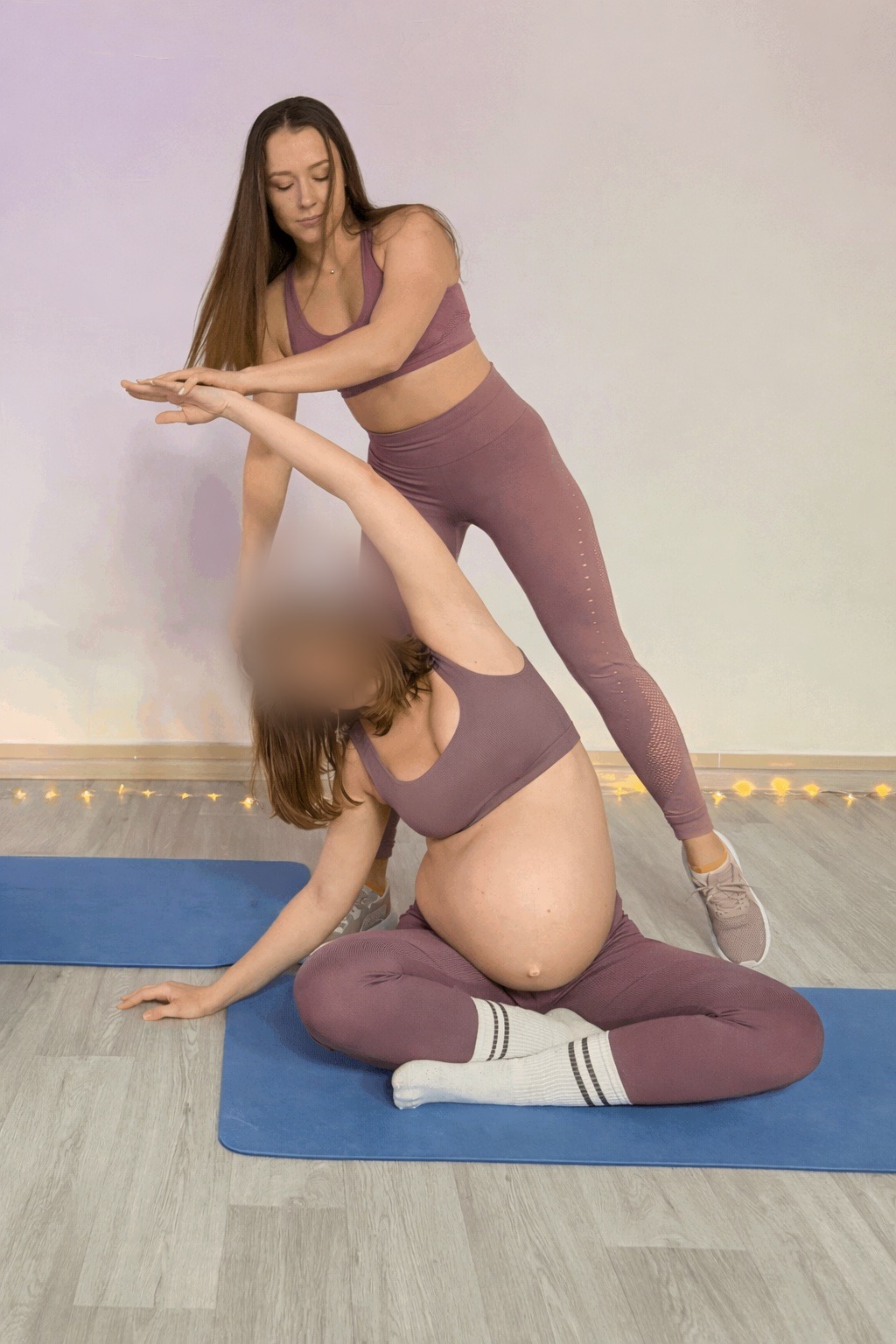
In brief. Training in the first trimester (1–13 weeks) with a normally progressing pregnancy and your doctor’s clearance is not only allowed but useful: research confirms that physical activity in early pregnancy does not increase the risk of miscarriage. The main thing is not to “do the same as before, only easier”, but to adapt the programme to the physiology: rising progesterone brings drowsiness and fatigue, relaxin starts to soften ligaments slightly, blood volume rises, and 70–80% of women experience some level of nausea. What works: strength work at moderate load (drop your working weights by 20–30%), moderate cardio (walking, swimming, stationary bike), gentle stretching without maximum range, Kegel exercises, breathing practice. What to drop already: exercises that involve straining (heavy deadlifts, presses with breath-holding), sharp ballistic movements, jump rope, contact sports, anything with a risk of falling. The main intensity marker is even breathing during a set. With IVF pregnancies, no impact load in the first 12 weeks until normal progression is confirmed.
In a normally progressing pregnancy, physical activity in the first trimester does not increase the risk of miscarriage – this is a fact reflected in current clinical guidelines, and abruptly stopping your usual training “just in case” shifts your hormonal balance more than continuing the familiar load would.
First trimester and movement: why this is even a question
Training in the first trimester causes more anxiety than at any other stage. The logic is understandable: the baby has only just implanted, everything still feels fragile, and any extra effort seems risky. On top of that there is nausea, fatigue, and a sense that your body is no longer quite yours.
In practice, the first trimester is when thoughtful movement does not get in the way – it helps. Research confirms that physical activity in early pregnancy does not increase the risk of miscarriage in women with a normally progressing pregnancy. But there is a big difference between “you can move” and “you should train as before”. That is why the first trimester needs a deliberate approach, not just a guesstimate reduction in load.
What happens in the body in the first 12 weeks
To pick an appropriate load, you need to understand what the body is going through.
Hormonal shift. Progesterone levels rise sharply. This hormone supports the pregnancy, but the side effects are tangible: drowsiness, slower digestion, mood swings. Many women in the first trimester feel as if they are constantly under-slept – this is not laziness, it is physiology.
Relaxin starts working. Ligaments become more pliable. It is not as obvious as in the third trimester, but the process has begun. Joints are slightly less stable, and sharp movements at maximum range are best dropped already now.
Blood volume rises. The cardiovascular system adapts to new demands. In practice that can show up as dizziness when you change position quickly, a higher resting heart rate, and faster fatigue under a load that used to feel easy.
Nausea. In 70–80% of women, the first trimester comes with nausea. For some it is mild morning discomfort; for others it is a state where it is hard even to get off the sofa. Load should follow how you actually feel, not the calendar plan.
Which workouts are safe in the first trimester
If the pregnancy is progressing without complications and your doctor has not set restrictions, you can and should move. Here is what usually fits.
Strength training at moderate load
If you trained before pregnancy, you can keep doing familiar exercises with a small adjustment. It makes sense to lower working weights by 20–30% – not because it has become dangerous, but because the body is now spending resources elsewhere. Drop exercises that involve straining (heavy deadlifts, pressing with breath-holding) and sharp ballistic movements.
Squats, lunges, rows, presses – all of these are okay in an adapted version. The main marker: you should be able to maintain steady breathing throughout a set.
Walking
The simplest and most underrated form of load. 20–40 minutes of moderate-pace walking daily is not “nothing” – it is full cardio that supports circulation, helps with digestion, and improves mood. On days when you feel sick and have no energy for anything, walking can be the only training, and that is enough.
Swimming
Water takes load off joints and spine, gives gentle resistance, and helps you relax. Swimming is one of the most comfortable activities for the first trimester. One note: pay attention to water temperature (not above 32°C) and to pool hygiene.
Breathing practice
The first trimester is a good time to start working on diaphragmatic breathing. It is a skill you will use throughout pregnancy and directly in labour. More on technique and variations – in the article on breathing exercises for pregnancy.
Yoga and stretching
Gentle stretching and yoga work, if you exclude inverted poses, deep twists, and intensive stretching. Remember relaxin: the body lets you go deeper, but that does not mean you should.
What to skip
The first trimester is not the time to experiment with new high-intensity activities. The usual exclusions:
- Contact and high-risk sports. Martial arts, contact team games, downhill skiing, horse riding.
- High-intensity intervals. HIIT, CrossFit, Tabata – anything where heart rate stays high for long and your breathing breaks.
- Breath-hold exercises. Straining raises intra-abdominal pressure, which is undesirable in early pregnancy.
- Jumping and plyometrics. Impact load on joints that have already started to lose stability.
- Exercises lying on the belly. As the uterus grows this becomes physically impossible anyway, but already in the first trimester it is better to switch to alternative positions.
- Training in heat. Overheating in the first trimester is especially undesirable. Hot yoga, midday running in the sun, sauna after training – all out.
More on what loads usually do not suit pregnancy – in the article “What not to do during pregnancy: sport”.
How to structure a session: a practical format
If you are just starting or returning to load after a break, here is an approximate session structure for the first trimester:
-
Warm-up (5–7 minutes). Walking on the spot, gentle circular joint movements, breathing setup. No jerks – the body should switch on gradually.
-
Main part (20–30 minutes). 5–7 exercises with body weight or light resistance: squats, supported lunges, band rows, push-ups against a wall or bench, quadruped work for the back and glutes. Rests between sets – by feel, not by timer.
-
Breathing and pelvic floor (5 minutes). Diaphragmatic breathing with gentle pelvic floor activation. Even 5 minutes of daily practice gives a noticeable result by the end of pregnancy.
-
Cool-down (5 minutes). Gentle stretching seated or standing, relaxation.
Total duration – 35–45 minutes. Frequency – 2–4 times a week. On days with strong nausea or fatigue, you can stick to walking and breathing.
When to postpone first-trimester training
There are situations where load needs to be coordinated with your doctor or temporarily dropped entirely:
- Bloody discharge of any amount.
- Strong pain in the lower abdomen or back.
- A diagnosis of “threatened miscarriage” or uterine tone.
- Severe nausea with vomiting more than 3–4 times a day (hyperemesis).
- Dizziness and fainting.
- Multiple pregnancy (individual approach needed).
- IVF pregnancy (at minimum until heartbeat is confirmed, often until the end of the first trimester).
If your doctor allows load but with restrictions – that does not mean “nothing is allowed”. It means the programme should be adapted to your specific situation.
Three rules for the first trimester
Instead of a long list of recommendations – three reference points that work in any situation.
Breathe steady. If your breathing breaks – the load is too high. This is the simplest and most reliable indicator of an acceptable intensity. The talk test: you should be able to say a phrase of 5–6 words without gasping.
Listen to fatigue. If after a session you feel a pleasant lightness – the load was right. If you collapse on the sofa for two hours – it was too much. The first trimester is not the time to “push through”. The body is building the placenta and laying down the baby’s organs. It needs resources.
Do not start at maximum. Even if before pregnancy you trained 5 times a week with heavy weights. The first 2–3 weeks after a positive test are an adaptation period. Start at 50–60% of your usual load and build up by feel. More on how to structure a training programme by stage – on the page Pregnancy.