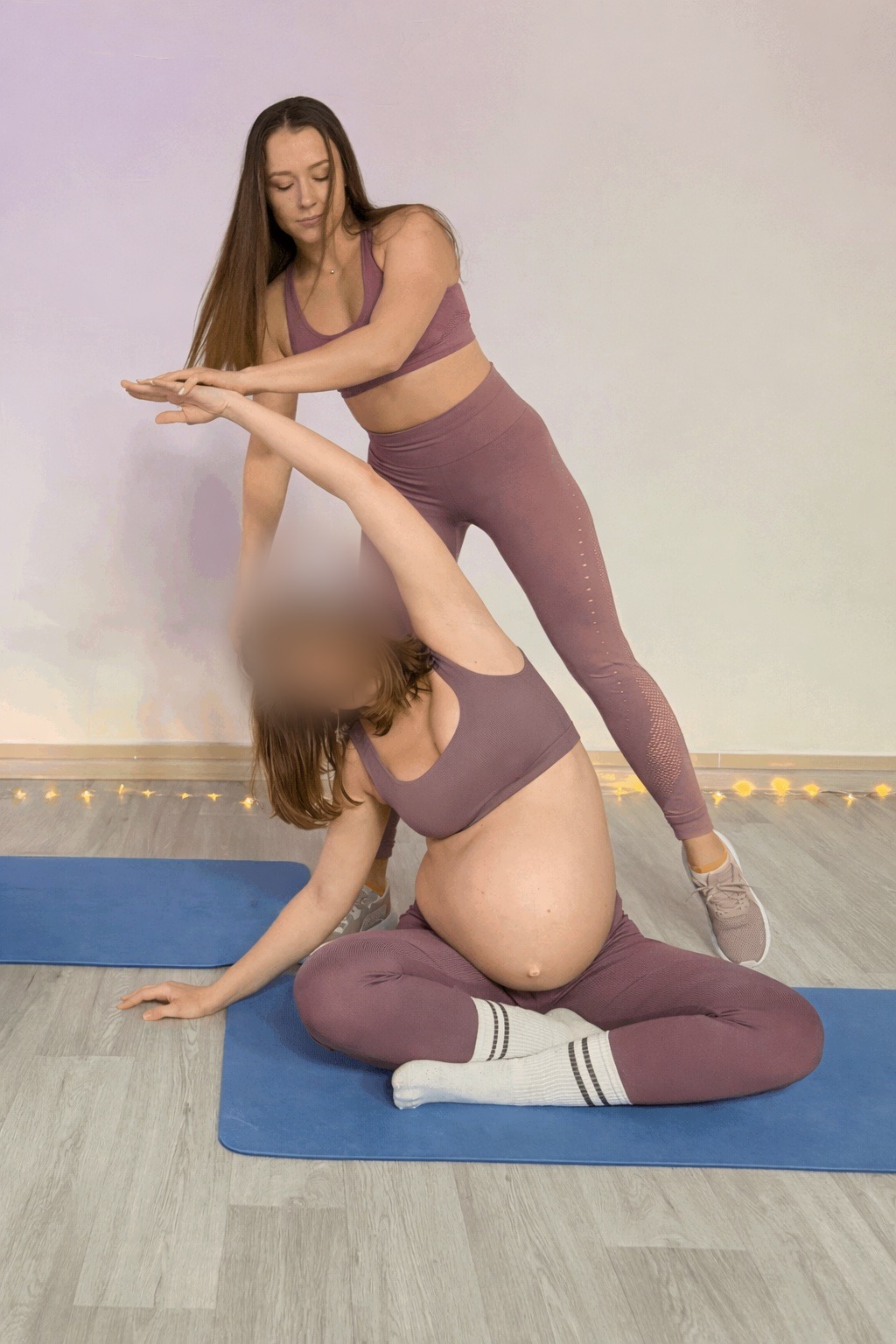
In brief. The third trimester (28–40 weeks) is not a time to drop training but a time to shift priorities: from strength and cardio to breathing, pelvic mobility, relaxation, and preparation for labour. What changes in the body: the centre of gravity shifts forward and up, the uterus presses on the diaphragm (shorter breath), relaxin is at its peak (less stable joints), oedema and fatigue, risk of symphysis pubis pain and sacroiliac joint pain. Intensity control – not by heart rate (it is elevated even at rest) but by the talk test: you should be able to say a 5–6 word phrase without gasping, RPE 4–6 out of 10. Drop supine positions, crunches, leg raises, long planks, deep squats and lunges without support, balance exercises without support. The deep squat is done with a wide stance and support against a wall or partner. Immediate stop signs: vaginal bleeding, leaking fluid, severe headache, chest pain, calf swelling, regular painful contractions, a sharp drop in baby’s activity after training. Total immobility in the third trimester often makes back pain worse, not better.
You cannot control training intensity in the third trimester by heart rate – it is naturally elevated even at rest; the working reference is the talk test: you should be able to say a phrase of 5–6 words without gasping and hold RPE at 4–6 out of 10.
What happens in the body in the third trimester
The third trimester runs from week 28 to week 40, though the actual length varies. At this stage the body goes through serious changes that directly affect how and what you can train.
The belly grows significantly. This is not just a visual change – it is a shift of the centre of gravity forward and up. The lower back takes extra load, balance worsens, familiar movements take more effort.
Breathing becomes shorter. The uterus rises and presses on the diaphragm, reducing lung volume. You may notice you are breathless going up stairs or with movements that used to cause no difficulty at all. Closer to birth, when the baby drops, breathing usually becomes easier.
Joints are even less stable. Relaxin is at its peak by the third trimester. Ligaments are softened, joints are mobile – but this mobility does not mean improved flexibility. It means reduced stability and a higher risk of injury.
Oedema and fatigue appear. Increased blood volume, fluid retention, pressure of the uterus on vessels – all of this leads to swelling, especially in the legs. Fatigue piles up: insomnia, frequent waking, physical discomfort all drain energy.
Pelvic and lower back pain can bother you. Symphysis pubis pain, sacroiliac joint pain, sciatica – common companions of the third trimester. They do not mean you must stop moving altogether, but they do call for adaptation.
Why train in the third trimester
A reasonable question: if everything hurts, breathing is hard, and energy is low, why train at all? Concrete answers:
- Preparing for labour. Labour is physically demanding. Endurance, breath control, a strong pelvic floor – all of this helps in labour and can make it more manageable.
- Lower pain levels. Regular movement helps reduce back and pelvic pain. Total immobility, paradoxically, often makes the discomfort worse.
- Mood support. Physical activity stimulates endorphin release and helps with the anxiety that often rises towards birth.
- Faster postpartum recovery. Women who train until the end of pregnancy usually recover faster – both physically and emotionally.
- Weight gain control. Excessive weight gain in the third trimester can complicate labour and slow recovery. Appropriate activity keeps things within reasonable limits.
What to adapt
The third trimester is not the time for new records. It is the time to adapt what you were doing to a body that has changed. Specific recommendations:
Intensity: lower it
General rule: you should be able to talk during the exercise. If you cannot say a phrase of five or six words without gasping – the load is too high. Heart rate should not exceed 140 bpm, though for trained women the threshold can be a little higher. But the talking marker is more reliable.
This does not mean the workout should be “nothing”. You can still feel effort. The effort should just be controlled, not maximal.
Body position: change it
Drop everything done lying on your back. Use seated, standing, side-lying, and quadruped positions. If you used to do a glute bridge lying down, now it is a side-lying or wall-supported version. If you had floor exercises, move them to a stability ball or use an inclined bench.
Range: reduce it
Deep squats can be replaced with parallel squats with support. Deep lunges – with short steps. Wide stretches – with gentle, controlled movements. Remember relaxin: joints let you go deeper, but that does not mean you should.
Ab load: rethink it
Classic ab work should by the third trimester be fully replaced with deep core work. No crunches, leg raises, or long-hold planks. Instead – breathing techniques with transverse abdominis activation, gentle quadruped stabilisation.
Balance: add support
Any exercise that needs good balance is done with support – wall, chair, railing. This is not weakness, it is common sense: a fall in the third trimester is a serious risk.
What to add
The third trimester is a good time to specifically prepare the body for labour. What makes sense to include:
Breathing work
Diaphragmatic breathing is not just “breathing exercises”. It is a tool you will use directly in labour. The ability to consciously manage your breath helps you cope with pain, relax the pelvic floor, and stay in control during stress.
Practise slow inhalation with rib expansion and a quiet long exhale. Try breathing in different positions: seated, standing, on all fours, on your side. The more familiar this breath becomes, the easier it is to use in labour.
Pelvic floor work
By the third trimester the pelvic floor is carrying the maximum load – the weight of the baby, uterus, and amniotic fluid. Maintaining pelvic floor tone helps both in labour and in postpartum recovery.
But it matters not only to contract but also to relax. In labour the pelvic floor has to be able to open up, and learning to consciously release this area is no less valuable than learning to contract it. More on this in the article “Kegel exercises during pregnancy”.
Gentle hip mobilisation
Circles with the pelvis, gentle rocking on a stability ball, butterfly pose with support – all of these help maintain hip mobility and prepare the pelvis for labour. Important: do not try to “open” the pelvis by force. Gentle, repeated movements work better than aggressive stretching.
Supported squats
A deep squat with a wide stance (with support against a wall or partner) is one of the labour positions. Practising this movement helps prepare the body for birth. Start with shallow squats and gradually increase the depth if it stays comfortable.
Walking
A simple, accessible, and very effective form of activity. 20–30 minutes of moderate-pace walking daily helps maintain cardiovascular endurance, reduce oedema, and improve mood. In hot weather – only during cool hours, with water.
When to stop: warning signs
There are situations where you need to stop the workout immediately and contact a doctor:
- Vaginal bleeding. Any amount of blood is a reason to stop immediately.
- Leaking amniotic fluid. If you notice unusual discharge – stop the session.
- Severe headache or dizziness. Do not try to “push through” – it can be a sign of raised blood pressure.
- Chest pain or shortness of breath at rest (not during load).
- Pain or swelling in the calf. Can indicate thrombosis.
- Regular painful uterine contractions. Irregular Braxton Hicks are normal. Regular and painful are a reason to see your doctor. How to tell one from the other, and why the belly turns hard at all – in the guide to uterine tone during pregnancy.
- A sharp drop in baby’s activity. If after a workout you notice the baby is moving significantly less than usual – contact your doctor.
Beyond emergencies, there are daily signals to watch: if after training you feel significantly worse rather than better, the load needs revising. Third-trimester training should give energy, not drain it.
A sample session format
A third-trimester session might look like this:
- Warm-up (5–7 minutes): walking on the spot, gentle circles with shoulders and pelvis, breathing setup.
- Main part (20–25 minutes): 4–6 exercises with moderate load – supported squats, rows with a light weight or band, quadruped work, hip mobilisation.
- Breathing and pelvic floor (5–7 minutes): diaphragmatic breathing, pelvic floor contraction and release, visualisation.
- Cool-down (5–7 minutes): gentle stretching seated or side-lying, relaxation.
Total duration – 35–45 minutes. If energy is low – shorten the main part. If you feel good – you can add a few minutes of walking. Frequency – 2–4 times a week, depending on how you feel.
How to get a programme adapted to your stage
The third trimester is a period when an individual approach matters especially. One woman at 32 weeks feels great and wants to keep up strength work; another at the same stage can barely walk because of symphysis pain. A universal programme does not work here.
At the first session we go through your specific situation: stage, how you feel, your background, restrictions, your doctor’s recommendations. Based on that we choose exercises and load that are safe and useful for you. Sessions are available in Samara and online; the first session starts from 1,600 roubles (online).
More on training during pregnancy – on the page Pregnancy. More on pelvic floor work – in the article “Kegel exercises during pregnancy”.
Related: swelling during pregnancy – what is normal and when to see a doctor.