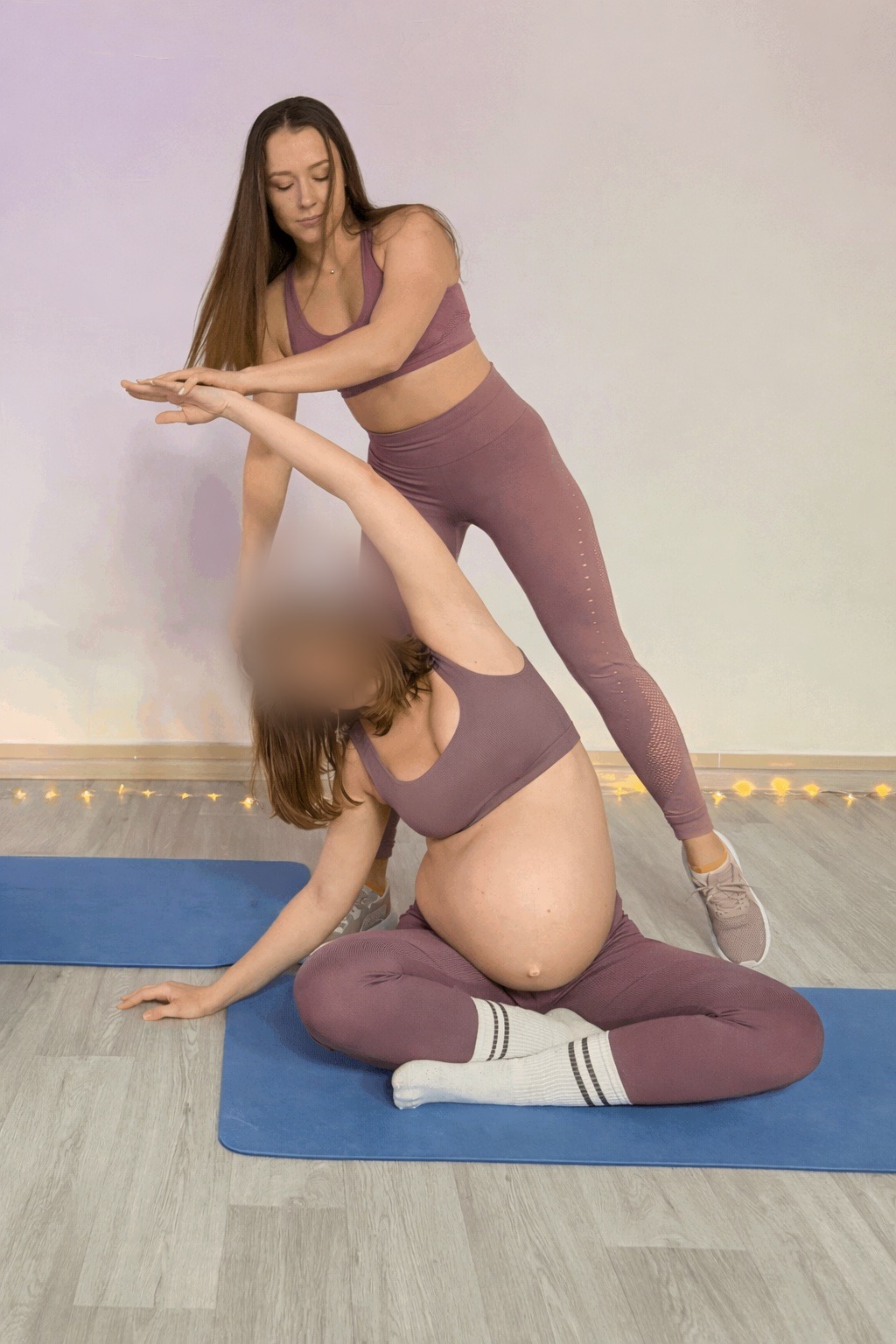
«They told me to wait 2 months before training, but my back is falling apart right now» – one of the most common complaints of the first postpartum weeks. It comes from a misunderstanding: «wait 2 months» refers to general strength and cardio, not to local back work. You can help your back from the first week – and this is exactly the period when it matters most.
The back works harder than usual with a newborn: feeding in a half-bend, rocking, carrying the baby on one side, sleeping in twisted positions. Let us break down what to do, stage by stage.
Why the back hurts most in the first weeks
In the first 6-12 weeks after birth several factors converge at once.
Relaxin is still active. The hormone that softened the pelvic ligaments before birth does not leave immediately – it keeps working for at least 4-6 months. The ligaments of the pelvis, lower back and sacrum are lax, the joints less stable. Any one-sided load is tolerated worse than before pregnancy.
The front corset is not working. The linea alba is stretched from pregnancy, the transverse abdominis is weakened. This is normal at this stage, but without the front corset the whole axial load falls on the lumbar muscles. They overload, and by evening the back drags.
Daily life overloads asymmetrically. The baby is usually on one arm. Feeding happens in a half-bend with a rounded back. Sleep comes in 2-3 hour stretches with no real recovery. The baby is lifted from the crib through a forward bend. Each movement is small, but they continue all day.
Fatigue from birth. The pelvic girdle and core are weakened, posture automatically «sags»: the head drifts forward, the shoulders rise to the ears, the chest closes. The lower back compensates.
All together, the back in the first postpartum weeks is one of the most vulnerable areas. Which is why it needs attention now – not «in 2 months».
What the 6-week check clears – and what it does not
The doctor’s clearance at 6 weeks after a vaginal birth (8-10 after a C-section) is permission for general training: strength, cardio, swimming, group classes. How the whole period is structured is in Postpartum recovery week by week.
Local restorative back work is in the same category as breathing exercises and Kegels. It does not require separate clearance and is allowed from the first days after an uncomplicated birth. This is not «training» – it is part of recovery.
After a C-section the window shifts. General training – from week 8-10 with the doctor’s clearance (details in Training after a C-section). Local back work – from week 4: the first 3-4 weeks are breathing and the gentlest movements only, to avoid loading the scar.
What you can do from week one
Three exercises we start on day 3-7 after a vaginal birth and from week 1 after a C-section.
Diaphragmatic breathing. Lying on your back, knees bent, feet on the floor. One hand on the belly, the other on the chest. Inhale through the nose for 4 counts – the belly gently expands, the hand on the belly rises, the hand on the chest stays. Exhale through the mouth for 6 counts – the belly returns, the pelvic floor gently draws in. 5 minutes in the morning and 5 in the evening.
This is not «relaxation breathing», although relaxation comes. It is activation of the transverse abdominis and pelvic floor – the front and lower corset around the lumbar spine. Without them the lower back works for itself and for the two other layers.
Child’s pose. Kneel, spread the knees slightly wider than the pelvis, lower the belly and chest down, stretch the arms forward. Forehead on the mat or on folded hands. Breathe calmly for 30-60 seconds. This is a gentle stretch of the whole back line – from the lower back to the neck. If the belly is in the way, place a pillow under the chest.
Knee hugs on the back. Pull the bent knees to the chest and wrap your arms around them. Hold 30 seconds, breathe. This stretches the lower back and releases the tension that builds up through the day of half-bent feeding positions.
After a C-section, pull in only one knee at a time for the first 2 weeks – to avoid loading the scar.
What is added in weeks 2-3
From week 2-3 after a vaginal birth and week 3-4 after a C-section we add pelvic and thoracic mobility.
Pelvic rocking on the back. Knees bent, feet on the floor. Slowly roll the lower back along the floor: on the exhale tilt the pelvis slightly towards you (the lower back presses into the floor), on the inhale return to neutral. 8-10 times.
Cat on all fours. Palms under the shoulders, knees under the hips. On the exhale round the back up, on the inhale return to neutral. No lumbar arch in the bottom phase – neutral, not «cow»: arching with a weakened front corset loads the lower back. 6-8 reps.
Head turns with breathing. Sitting or standing, slowly turn the head to the right to a comfortable limit on the inhale, hold 2-3 seconds, return on the exhale. Same to the left. 5 per side. Releases the tension of the neck-thoracic junction, which pulls down and amplifies lumbar pain.
What is added in weeks 4-6
From week 4-6 after a vaginal birth, and with the doctor’s clearance after a C-section.
Glute bridge. Lying on your back, knees bent. On the exhale gently lift the pelvis to a straight «knees-pelvis-shoulders» line. No higher – hyperextending the lower back is not the goal. 8-10 reps. It wakes up the glutes, which often «switch off» with a newborn, and takes load off the lower back.
Side plank on the knee. Lying on your side, elbow under the shoulder, bottom knee bent and resting on the floor. On the exhale lift the pelvis into a straight line from shoulder to knee. Hold 15-20 seconds, 2 sets per side. It activates the quadratus lumborum and the lateral core.
Gentle bird dog. On all fours, slowly extend the right arm forward and the left leg back at the same time. Hold 2-3 seconds, return. 5 per diagonal.
After week 6 this base can be combined with 30+ minute walks, swimming and gentle practices for mums. The full plan for this period is in Postpartum recovery exercises by week.
What not to do in the first 6 weeks
In the first 6 weeks after a vaginal birth and 8-10 after a C-section, avoid:
- Direct ab work (lifting the torso from lying) – loads the linea alba and provokes or worsens diastasis.
- The classic plank – the same problem plus top-down load on the pelvic floor.
- Deep weighted forward bends – overloading the lower back while the deep muscles are weak.
- Deep yoga twists – the joints are unstable due to relaxin, high strain risk.
- Long sitting in one position – change position every 30-40 minutes.
- Carrying the baby on one side only – switch arms every 10-15 minutes.
Daily-life rules for the back with a newborn
Exercises are one part of recovery. The other part is daily life. Without correcting it, exercises work at half strength.
- Feed with a pillow behind the back and under the baby’s arm, so the shoulders do not rise to the ears. Back straight, supported by the chair.
- Switch arms when carrying the baby every 10-15 minutes. For longer carrying – a sling or carrier that spreads the weight over both shoulders.
- Lift the baby from the floor, crib or car seat through a squat, not a forward bend.
- Sleep on your side with a pillow between the knees – it offloads the lower back.
- Change sitting position every 30-40 minutes, at least walk around the room for 1-2 minutes.
In the first 1-2 weeks a postpartum binder can also support the lower back – as a temporary crutch, not a replacement for exercise.
When to see a doctor
See a neurologist or orthopaedist if:
- one-sided pain radiates into a leg;
- it does not resolve with position changes and exercise within 2-3 weeks;
- it worsens at night or at rest;
- it comes with numbness, tingling or weakness in the leg;
- it sharply worsened after a specific movement.
See a gynaecologist if lower back pain comes together with lower abdominal pain, bleeding or its return, a feeling of pressure or «something dropping» in the vagina, or fever.
If you waited 2 months – how to catch up
If you only now learned that back work could have started earlier – no harm done. A 2-4 week programme:
- Week 1: diaphragmatic breathing + child’s pose + knee hugs only.
- Week 2: add pelvic rocking + the cat.
- Weeks 3-4: add the bridge and the side plank on the knee.
By the end of week 4 you will have caught up with those who started in week one. The body responds quickly to regular work.
In short
Local back work is allowed from the first week after a vaginal birth and from week 4 after a C-section. The doctor’s clearance at 6 weeks refers to general training, not to this work.
The base for the first 6 weeks: diaphragmatic breathing, child’s pose and knee hugs from week one; pelvic rocking, the cat and head turns from week 2-3; the bridge and the side plank on the knee from week 4-6.
The back works harder than usual with a newborn. The earlier the restorative work starts, the lower the chance of chronic lumbar pain in the second year after birth.
This article was also published in my blog on T-Zh (in Russian): What you can do for your back in the first 6 weeks after birth.
A separate case is a lower back that was already weak before pregnancy. I cover it in my answers to readers: postpartum recovery, reader questions. The back is only one part of the picture – how to build the whole recovery, step by step and by timeline, is covered in the guide Postpartum recovery.
Anastasia Nikolskaya is a perinatal fitness and postpartum recovery trainer. In person in Samara and online across Russia.
This article is for informational purposes and does not replace medical advice. After a complicated birth or with any diagnoses, agree the programme with your OB-GYN.