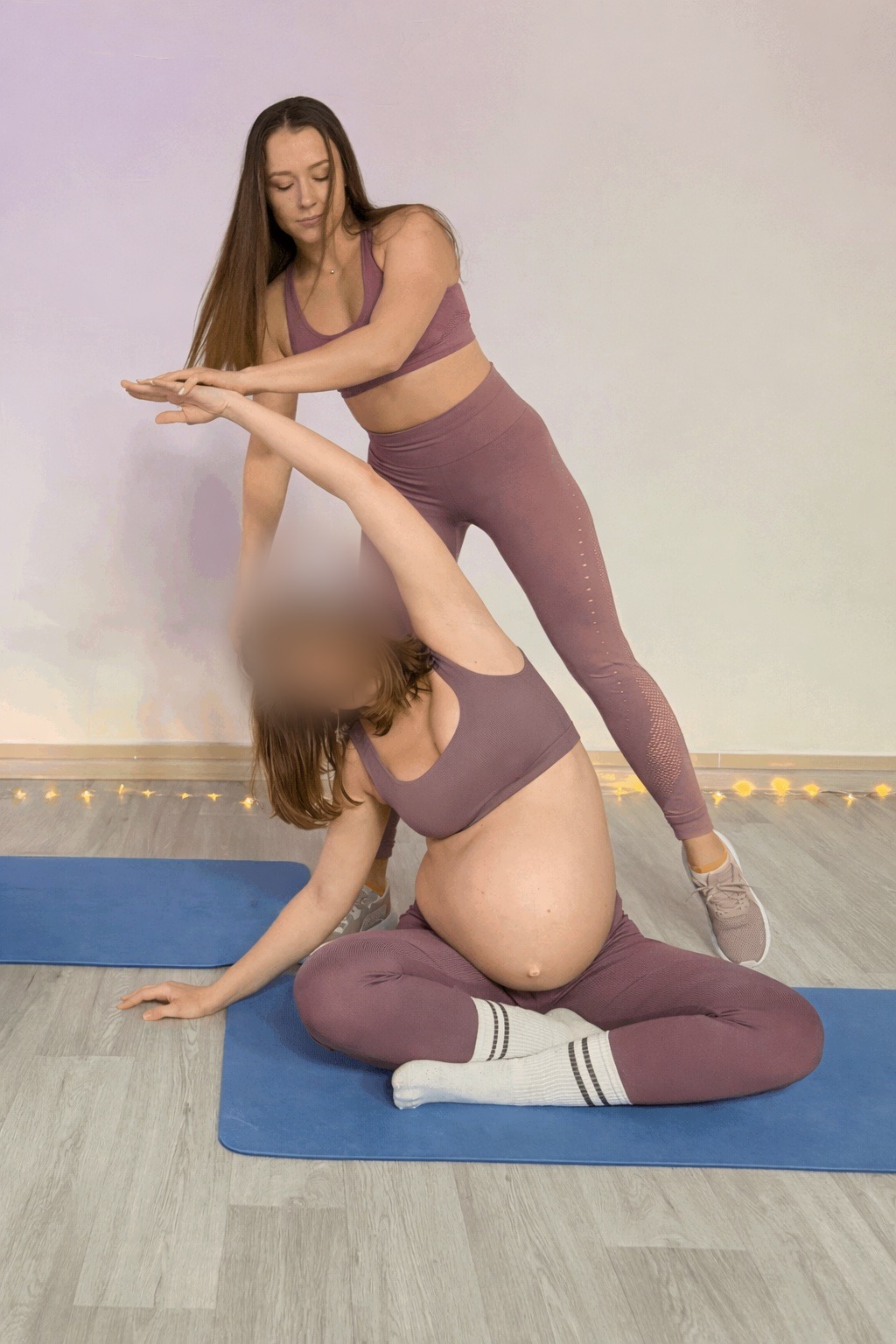
Over the summer I took part in a joint AMA on postpartum recovery hosted by a large Russian consumer publication. Readers asked questions in the comments and three specialists answered: an obstetrician-gynaecologist, a psychotherapist and me as a perinatal fitness trainer. My part covers movement, load, the back, diastasis recti, the pelvic floor and the return to sport.
The AMA has now closed. Below are all the questions addressed to me, answered in more depth than a comment allows.
«My lower back was already weak before pregnancy»
The question was this: if a woman had a weak lower back before pregnancy and birth, how does she avoid falling apart completely afterwards, with the constant load a baby brings?
One clarification changes the whole logic of the work. A «weak lower back» is almost always not weak but overloaded. The lumbar muscles take on work that belongs to the glutes, the transverse abdominis and the pelvic floor. Before pregnancy that showed up as occasional discomfort after a long day. After birth those muscles switch on less readily while the daily load multiplies, so the same weak link now speaks up all the time.
Having had back trouble earlier does not put you in a worse position. If anything the cause is already known and unchanged. There is only one bad scenario here: waiting for it to settle on its own. It will not settle until the glutes and the deep core take their work back.
Why «strengthening the back» is not the first step
Loading the lower back seems logical and usually makes things worse. Those muscles are already working overtime, and adding load adds a little more overload on top.
The order is different: first restore the muscles that unload the lower back, then add strength work.
What comes first
Roughly ten minutes a day:
Breathing with the transverse abdominis. Lying on your back, knees bent. Inhale into the lower ribs; on the exhale the abdominal wall draws gently inwards, as if fastening tight jeans. No bearing down, no breath holding. Five minutes. Without a working transverse abdominis everything else gets compensated by the lower back.
Pelvic mobility. Cat-cow on all fours and gentle pelvic rocking while lying down. The aim is not to stretch but to return movement to an area that currently behaves like one rigid piece.
Glutes. Glute bridge and side-lying leg abduction. Strong glutes are the main relief for the lower back: they take over hip extension that otherwise happens through lumbar arching.
A week-by-week plan is in a separate article: back pain after birth, exercises from week one.
Daily habits matter more than the mat
Ten minutes of exercise against fourteen hours of daily load is an unequal fight. So habits come first:
- carry the baby close to the centre of your body and switch sides rather than always using one hip;
- lift through the legs, not by bending with a rounded back – raise the cot and the changing table so you are not folding in half;
- when feeding, support the elbow and the lower back instead of hunching over the baby;
- avoid long periods standing with your weight on one leg, a habitual pose with a baby on the hip that tilts the pelvis.
What to leave out for now
Crunches, the classic plank, and forward bends with straight legs or added weight. That is exactly the load the lower back suffers from, and with an incompletely recovered linea alba it also pushes into the abdominal wall. On timing for abdominal work: when to train abs after birth.
When to add strength work
When the basics no longer provoke discomfort and you can feel the glutes working rather than only the lower back. From there, strength work centred on glutes and hamstrings. That is what builds durability for years, rather than endless rehabilitation.
When it is no longer a trainer’s question
See a doctor without waiting if pain shoots down the leg, there is numbness or leg weakness, pain wakes you at night at rest, it does not settle within two to three weeks, or urine leakage appears.
«When can I go back to strength training and my working weights»
A question from the publication’s sports editor, about timelines and protocols.
In fitness terms, postpartum recovery means restoring natural movement mechanics and adapting to a new life with a baby. Pregnancy changes the body profoundly, and it does not come back on a calendar – it comes back on evidence.
It depends on two things: how the birth went, vaginally or by caesarean and whether there were complications; and what your training looked like before and during pregnancy. With regular training and good body control behind you, muscle memory does its job and adaptation is quicker. Without a strength background we are essentially learning correct movement from scratch, and there is no rushing that.
Everything is individual and agreed with your doctor, but after an uncomplicated vaginal birth the stages average out like this:
- The first 6–8 weeks – everyday life. Sleep, walks, household routine. From training: breathing practice and gentle joint mobility for the neck, shoulders, wrists and feet.
- Months 2 to 4. Diastasis is assessed, then the deep abdominals and glutes come back into work gently, with careful pelvic floor work alongside.
- From months 4–6. Short sessions can start – bodyweight first, then bands and light dumbbells.
After a caesarean, add at least 2–3 weeks to the start of each stage, sometimes more, depending on how the scar heals and how recovery goes.
Previous working weights usually return no earlier than 6–9 months, and often closer to a year, through gradual progression.
One more thing: carrying the baby, the pram and the car seat is a real daily load in its own right. Which is why the best way to make this path easier is to think about it in advance. Sensible preparation before pregnancy and regular, intelligent training beforehand give the body the reserve that makes recovery far faster and gentler.
«What about yoga in the first 6–8 weeks?»
Classic yoga is best left alone for now. Many poses involve deep backbends and strong stretching and raise intra-abdominal pressure – planks, downward dog, balances. While the ligaments are still soft from relaxin and the pelvic floor is recovering, that is not safe.
What you can start with:
- breathing practice – gently brings the deep abdominals and pelvic floor back online;
- gentle mobility – light thoracic and neck movement to release the tension of feeding and rocking;
- relaxation and recovery – meditation, savasana, gentle self-massage.
Regular yoga classes are better resumed no earlier than 6–8 weeks and after clearance from your doctor. What prenatal practice leaves out and how it differs from a regular class is covered separately: prenatal yoga, safe poses by trimester.
«Can you identify your weak areas before pregnancy»
A question from the publication’s moderator: is it realistic to work out in advance what will give way, and prepare for it.
As a trainer: assessing your weak areas and preparing them before pregnancy is not just possible, it is the right thing to do. Nothing can be predicted with total certainty, but flagging the risks for the musculoskeletal system and building a preparation plan is entirely realistic.
Here is what we assess and work on before pregnancy.
1. Glutes and hamstrings. This is the main anti-gravity engine and the support for the pelvis. If the glutes are asleep, the load of a growing bump transfers straight to the lower back and the front of the thigh. Strong glutes before pregnancy are, quite literally, the rescue of your back.
2. Posture and pelvic position. If there is already a pronounced lumbar curve or a tilted pelvis, then once the centre of gravity shifts forward in pregnancy, the load on the lower back and sacrum multiplies.
3. Habitual muscular tension. With existing tension in the shoulders, neck or mid-back from desk work, a growing bump and daily load will only make it worse. The task is to release the spasm and teach the body to move freely.
4. The state of the feet. Pregnancy brings relaxin, and ligaments soften. If the foot already tends to flatten, it will drop further under the added weight, and that feeds straight into the joints and the pelvis.
5. The deep muscles. We look at how the pelvic floor, diaphragm and deep abdominals work. If they are in hypertonus or, conversely, not switching on, the risk of diastasis and leakage after birth is higher.
The conclusion is simple: the better the base before pregnancy – a working muscular corset, active glutes, the skill of controlling body and breath – the faster and easier the recovery. It is far easier for a body to return to a shape it already had.
A free preconception training programme focused on these areas is available here: programmes by phase.
«What about feet that are already flat»
The foot is linked to the leg muscles and posture through myofascial chains. If the glutes are asleep, the load on the feet rises sharply. Working on posture and the leg muscles takes that excess pressure off. But the main emphasis is mobility and activation of the small muscles of the foot itself.
What to do:
- Ball release, 1–2 minutes. Roll the foot over a tennis or massage ball from heel to toes, paying attention to the arch.
- Toe fan. Spread the toes as wide apart as you can.
- Separate toe lifts. Lift only the big toes first, then only the four smaller ones.
- Foot rolling. Gently roll the foot from the outer edge to the inner edge.
- Towel scrunch. Gather a napkin or light cloth using only your toes.
On insoles: they unload the foot well if your legs tire quickly. But they do not train muscle on their own – under artificial support the foot relaxes even further. The working approach is insoles for comfort on long walks, always combined with daily foot exercise.
«I still have the birth ball – is it any use now»
A reader asked whether the ball is worth keeping after birth or worth selling.
An exercise ball suits both gentle postpartum recovery and settling the baby. Cover it with a sheet, and work with the baby 40–60 minutes after a feed.
With the baby:
- Rocking on the tummy. Place the baby tummy-down on the ball and rock gently back and forth and in circles. Always hold at the pelvis and thighs, never by the arms or legs. It helps with colic and trapped wind.
- Rocking on the back. Place the baby back-down on the ball, supporting the tummy gently. It helps release tension and relax the body.
- Rocking in arms. Sit on the ball holding the baby and bounce lightly. The baby settles, and your back and knees are spared the load.
For yourself:
- Pelvic circles. Sitting on the ball, rock the pelvis back and forth and in circles. It improves circulation in the pelvis and releases the lower back.
- Thoracic stretch. Kneel in front of the ball, place your hands on it and roll forward, lowering the chest towards the floor. Excellent for the neck and shoulders after feeding.
- Pelvic floor breathing. Sitting tall on the ball, gently draw the pelvic floor up on the exhale. The ball gives good feedback to the muscles.
- Leg and lower back release. Lie on your back with your calves resting on the ball, knees at 90 degrees. Breathe there, or rock the ball gently side to side with your legs. It relieves swelling in the legs and unloads the lower back.
The questions that come up most often
- Postpartum recovery: where to start and in what order
- Pelvic floor after birth
- Diastasis recti exercises after birth
- When to start returning to activity after childbirth
This article is informational and does not replace medical advice. Clearance from your obstetrician-gynaecologist is needed before returning to exercise after birth.