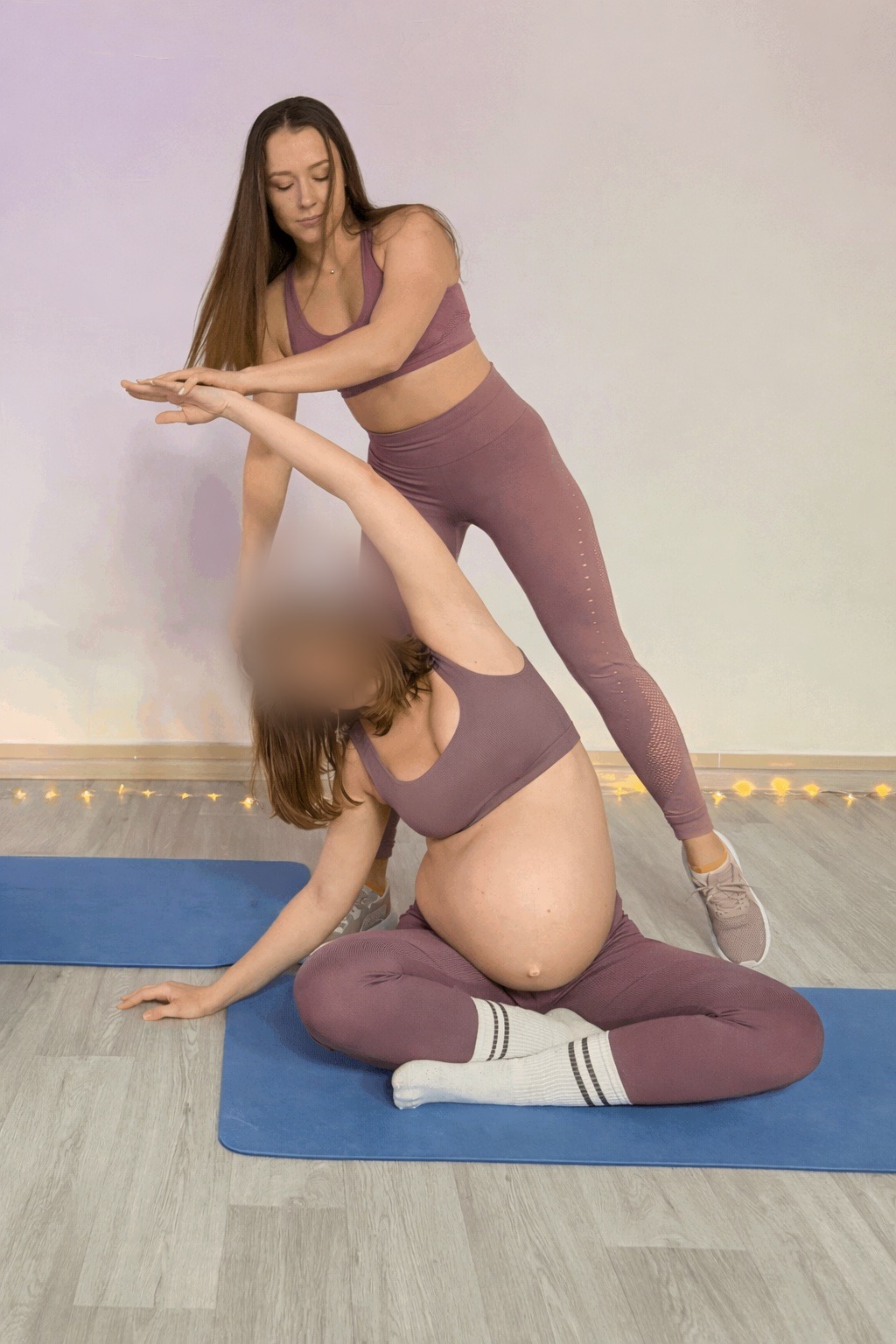
The most common question after discharge: “What exercises should I do to recover?”
The answer depends on the week. The first days call for one approach, week three for another, and three months out – something else entirely. Following random internet routines can worsen diastasis recti, overload the pelvic floor, or stress a C-section incision.
Below is a concrete week-by-week plan suitable for independent use. If you feel pain, pressure downward, or anything unusual – that is a signal to consult a specialist, not to push through.
Important. This material is for informational purposes and does not replace a face-to-face consultation with an obstetrician-gynaecologist. Get clearance from your doctor at your postpartum check-up – typically at 6–8 weeks – before returning to exercise.
Weeks 1–2: Breathing and pelvic floor only
Right after birth, your body is busy repairing tissue, normalising intra-abdominal pressure, and adjusting hormonally. Strength training at this point is not “getting back faster” – it is additional stress.
What is safe from day one:
Diaphragmatic breathing
Lying on your back or side, one hand on the ribs, one on the abdomen. Inhale through the nose – belly and ribs expand, chest stays still. Long exhale through the mouth – belly gently draws toward the spine, pelvic floor lifts slightly on its own. 5–7 minutes morning and evening. This is not a warm-up – it is restoring the diaphragm–pelvic floor connection that is disrupted during birth.
Gentle pelvic floor contractions (Kegel)
Lying on your back, knees bent. On the exhale – gently lift the pelvic floor muscles as if stopping the flow of urine, hold 3–5 seconds. On the inhale – fully release. 10 repetitions, twice a day. Do not grip with maximum force.
If you had a vaginal birth with sutures, start on day 3–5 once acute pain has settled.
Pelvic tilts
Lying on your back, knees bent, feet flat. On the exhale – gently roll the lower back toward the floor (slight posterior tilt). On the inhale – return. 10–15 repetitions. Releases lumbar tension and gently activates deep abdominals.
After C-section in weeks 1–2: breathing only. Kegels and pelvic tilts – with your doctor’s approval, usually from day 10–14 if there are no complications.
Weeks 3–5: Adding gentle movement
Incisions have healed and the initial acute exhaustion has lifted. The body is ready for a little more – “little” being the operative word.
Cat-cow on all fours
On hands and knees, palms under shoulders, knees under hips. Exhale – round the spine (cat), head drops. Inhale – gentle thoracic extension (cow), head lifts. 8–10 repetitions. Restores spinal mobility and addresses the lumbar loading that comes with feeding and carrying.
Glute bridge
Lying on your back, knees bent, feet flat. Press the lower back into the floor. Exhale – lift the hips, hold 2 seconds. Inhale – lower vertebra by vertebra. 10–12 repetitions, 2 sets. Strengthens the glutes and decompresses the lumbar spine without loading the abdomen or incision.
Child’s pose
From all fours, sit hips back toward heels, arms forward. Hold 1–2 minutes. Releases the entire posterior chain and reduces neck and upper-back tension from feeding.
Walking
An underrated tool. 15–20 minutes of easy walking daily stimulates circulation, reduces DVT risk, lifts mood, and gently activates the whole body. Pace – comfortable enough to hold a conversation.
After C-section in weeks 3–5: glute bridge from week 4–5 only, and only if there is no pulling sensation at the incision site.
Weeks 6–8: Returning to load after your check-up
At the 6–8 week check-up, your doctor assesses the cervix, incision (C-section), and uterine involution. This is the threshold for more active recovery – but only with a positive clearance.
Before adding load, check for diastasis recti. Lie on your back, knees bent. Slowly curl your head and shoulders as for a crunch. Use two fingers to feel along the midline at the navel: if your fingers sink more than 2 finger-widths, diastasis is present. In that case, direct abdominal exercises (crunches, supine leg raises) remain off-limits.
What to add:
Seated resistance band row
Sitting on the floor, legs straight, band looped around feet. Exhale – pull elbows back, draw shoulder blades together. Inhale – return. 12–15 reps, 2–3 sets. Strengthens the back muscles that carry the baby. No intra-abdominal pressure spike.
Wall sit
Back against the wall, feet stepped forward. Slowly slide down to 90–100° knee angle. Hold 3–5 seconds. Rise. 10–12 repetitions. A safe squat alternative with spinal support and controlled knee tracking.
Side-lying plank from the knee
Side-lying, forearm support, lower knee on the floor. Lift the hips into a straight line from knee to shoulder. Hold 15–20 seconds, 2–3 sets per side. Trains the lateral core without loading the linea alba.
After 3 months: full programme
If diastasis has closed or is within 1 finger-width, and the pelvic floor functions normally (no leaking with coughing, jumping, or sneezing) – you can progress to a full programme. This means functional loading: weighted squats, deadlifts, push-ups, lunges. Ideally under a trainer’s supervision to rebuild technique after pregnancy.
When not to exercise
Regardless of the week – if any of the following apply, stop and see your doctor:
- Lochia (postpartum bleeding) increases or returns after a pause
- Pain or heaviness in the lower abdomen during or after exercise
- A sensation of downward pressure, as if something is “falling out”
- Urinary leakage under minimal load or at rest
- Pain at the C-section scar during movement
- Severe fatigue that does not resolve with rest
Most common mistakes
“I’m doing crunches to flatten my belly.” Crunches and supine leg raises create intra-abdominal pressure. With diastasis, this pushes the muscles further apart. In the first months, the postpartum belly is reduced through deep muscle work and general activity – not crunches.
“I started running at two months.” Running is impact loading on a pelvic floor that has not yet recovered. Returning to running is recommended no earlier than 12 weeks, and only after passing basic pelvic floor tests.
Frequently asked questions
Can I exercise with diastasis recti? Yes – the right exercises. Breathing, cat-cow, glute bridge, and band rows are safe. Crunches, full plank on extended arms, and supine leg raises are not. More on diastasis recti.
Is exercising while breastfeeding safe? Yes. Moderate exercise does not affect breast milk composition or taste. Sport while breastfeeding covers the evidence and timing recommendations.
When can I start after a C-section? Breathing from day one. Gentle movement from weeks 4–6. Full training after 8 weeks and only with medical clearance. Detailed C-section recovery plan.
Anastasia Nikolskaya – perinatal fitness trainer, Samara + online. Book a personal postpartum recovery session: @Anastassia_Nikolskaya
Related: back pain after birth – exercises from week one, stage by stage.