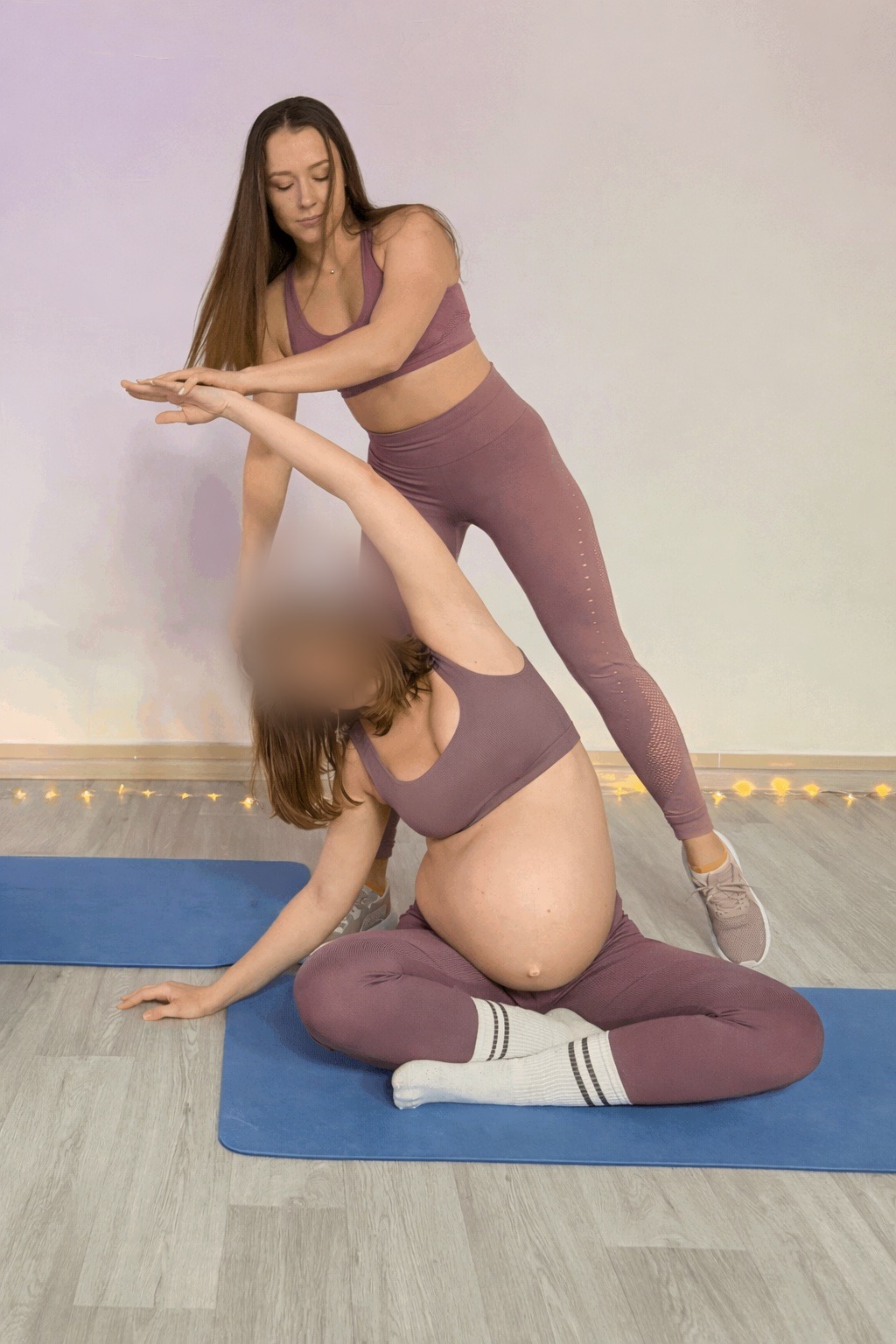
In brief. Training the abs after childbirth with classic crunches, planks, and leg raises is not appropriate in the first 3-4 months – most women still have diastasis recti in this period, and such exercises stretch the separation, raise intra-abdominal pressure, and load a weakened pelvic floor. Safe timeline: first 6 weeks – only breathing and gentle pelvic floor activation; weeks 6-12 after a doctor’s check – deep core muscles without crunches; 3-6 months – modified plank and light ab variations; from 6 months – full work, provided diastasis has closed and the pelvic floor is healthy. After a C-section, timelines shift by 2-3 months. Before any ab work, a diastasis check is needed: a gap wider than 2 fingers calls for an individual programme. The correct progression is from diaphragmatic breathing to transverse abdominis activation, then to functional exercises, and only then to classic abs.
A diastasis wider than 2 fingers along the midline is present in most women in the first months postpartum, and every classic crunch in this period does not strengthen but mechanically pushes the rectus muscles further apart.
Why not right after childbirth
The wish to recover a flat belly after childbirth is completely understandable. But the abs are exactly the area where rushing is most dangerous. And it is not about laziness or excessive caution – it is about physiology.
Over nine months of pregnancy, the rectus muscles stretch and separate to make room for the growing uterus. This phenomenon is called diastasis recti, and to some degree it is present in almost all women by the end of pregnancy. After childbirth, these muscles do not return to position instantly – they need time to rebuild tone and structural integrity.
If you start classic ab work – crunches, leg raises, planks – too early, you can not only slow recovery but worsen diastasis. Muscles that are not ready will separate further, and intra-abdominal pressure from incorrect exercises can negatively affect the pelvic floor.
First step – check for diastasis
Before thinking about any belly exercise, you need to understand the state of your muscles. A diastasis check is a simple procedure that can be done at home, but ideally with a specialist who can evaluate not only the width of the gap but also depth, and the muscles’ ability to generate tension.
How to check yourself: lie on your back, bend your knees. Lift your head and shoulders and use your fingers to feel the midline of the belly – up and down from the navel. If your fingers sink into a gap wider than two centimetres, this is a sign of diastasis that needs attention.
But width is not the only criterion. How the muscles respond to load matters too: do they create tension on activation, or do they stay soft. This is why a professional check gives a fuller picture. More on diastasis and how to work with it in a separate article.
Timeline: when what is appropriate
Every body recovers in its own way, but there are general guidelines.
First 6 weeks postpartum. This is the basic recovery period. The uterus returns to size; tissues heal. Training in the usual sense is not on the agenda. The most you do is breathing and gentle pelvic floor activation. Even this should be started only with good wellbeing and after a doctor’s check.
6-12 weeks. After a check-up with the gynaecologist and absent complications, you can begin work with deep core muscles. Not crunches and not planks, but gentle, controlled movement: breathing with transverse abdominis activation, coordination of breath and pelvic floor, gradual progression through arm and leg movement.
3-6 months. With good recovery and no significant diastasis, you can move on to more functional exercise. At this stage modified plank, light crunch variations, and unstable-surface work come in. But the keyword is gradually.
6 months and beyond. If the deep muscles work well, diastasis has closed or stabilised, and the pelvic floor is in order, you can return to full ab work. But even here, classic crunches are not the only or the best option.
Important: these timelines are guidelines. After a C-section, with complicated births, or with significant diastasis, each stage can take longer. That is normal.
Safe progression: from breathing to strength
The most effective strategy is to build load like a pyramid, with each level resting on the previous one.
Level 1: breathing. Diaphragmatic breathing is the foundation of all postpartum core work. On the inhale, the belly softly expands; on the exhale, it draws in and up. This is not “sucking in” – it is engaging the deep layer of muscle. It seems simple, but this skill determines the quality of every later exercise.
Level 2: deep core. Once breathing is mastered, add gentle transverse abdominis activation combined with pelvic floor work. Exercises are done lying down, on all fours, or seated. Example: on the exhale, softly engage the pelvic floor and transverse abdominis, hold for a few seconds, release on the inhale.
Level 3: coordination and challenge. When base activation is stable, add limb movement: heel slides, arm lifts, supine marches. The task is to keep the torso stable during movement.
Level 4: functional work. Move on to standing exercises, fitball, and light resistance. Modified plank on the knees, side plank, band work. At this level the abs are trained not in isolation but as part of the whole body.
Moving from one level to the next is by readiness, not by the calendar. If at the current level the muscles work correctly, there is no pain, no downward pressure – you can try the next.
Exercises to avoid
Some popular ab exercises create excessive intra-abdominal pressure and can be risky with unclosed diastasis or a weak pelvic floor.
- Classic crunches and sit-ups – create direct pressure on the linea alba and can widen the separation.
- Double-leg raises lying down – place huge load on the lower back and lower abs that the postpartum body is often not ready for.
- Full plank at an early stage – if deep muscles are not yet working, the body compensates with the lower back and surface muscles.
- Breath-holding and straining – raise intra-abdominal pressure and can negatively affect the pelvic floor.
- Jumping and high-intensity loading at early stages – the pelvic floor may not be ready for impact.
This does not mean these exercises are forever off-limits. It means they need a prepared base.
Individual differences: why there is no universal plan
Recovery after childbirth is a deeply individual process. Two women who gave birth on the same day can be at completely different stages of readiness three months later. Dozens of factors influence recovery speed:
- Type of birth – vaginal or C-section
- Number of pregnancies and births
- Muscle state before pregnancy
- Genetics and connective tissue
- Diastasis degree and its dynamics
- Breastfeeding and hormones
- Sleep quality and general state
This is why following universal online programmes is not the best strategy. A programme that is ideal for one woman can be completely wrong for another. More on the approach to postpartum recovery on a separate page.
In summary
Training the abs after childbirth is fine and necessary – but not right away and not with classic crunches. The safe path starts with breathing, goes through deep-muscle work, and gradually reaches full functional load. There is no need to rush: a consistent approach gives more durable and more attractive results than trying to force the process.
The most important thing is to start with an assessment of the current state. Without it, any programme is like treatment without diagnosis. Come to an intro session – we will check your body’s readiness, assess diastasis, and build a plan that fits you. Book here.