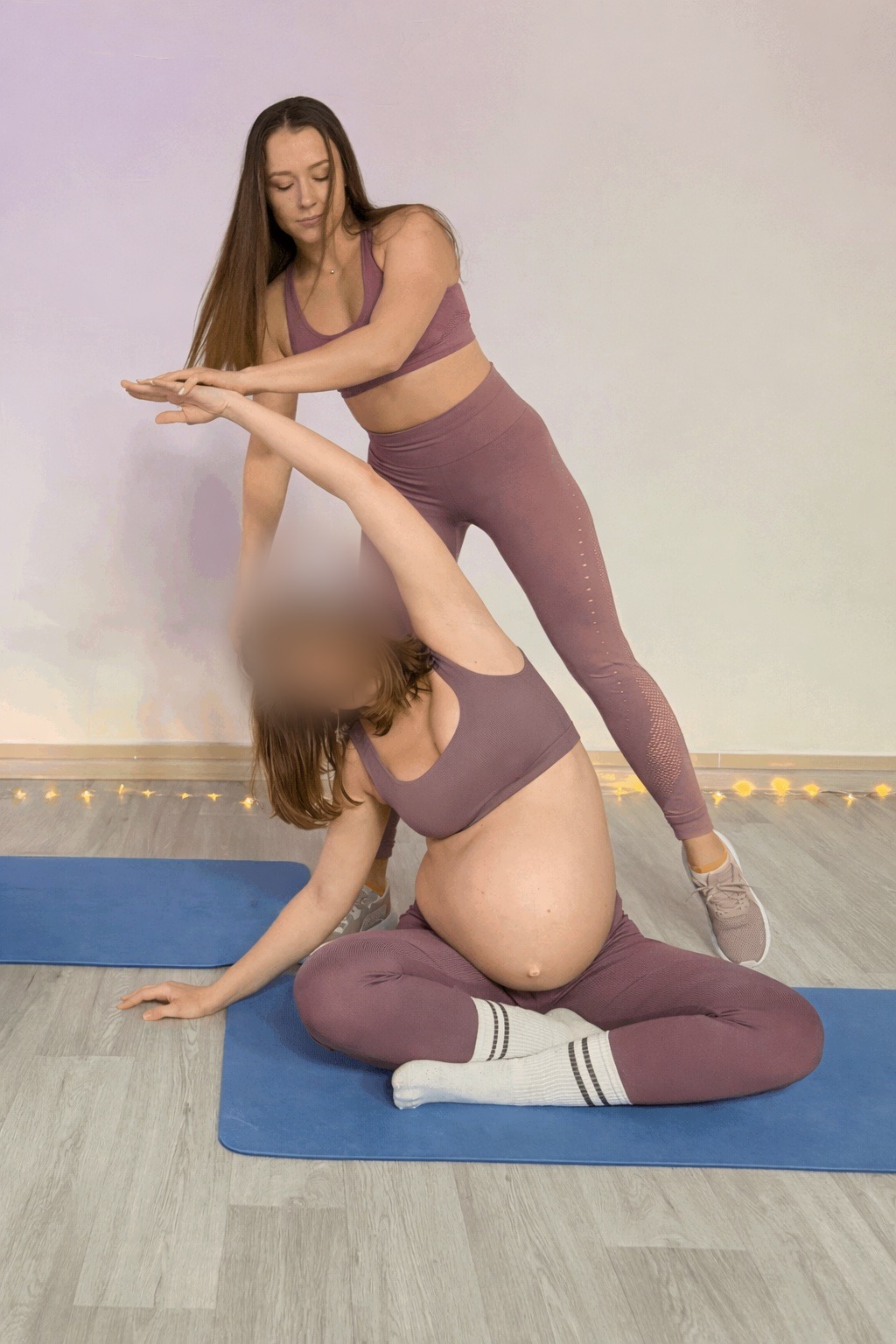
In brief. Most pregnant women in Russia work until 30 weeks – that is seven months of office, computer, meetings, and eight hours in a chair. Sedentary work during pregnancy overlaps with physiology: the growing uterus presses on the inferior vena cava, venous return worsens (oedema, varicose risk), the lower back picks up someone else’s load, the neck and shoulders suffer from the monitor under altered posture. Universal rule: every 30–45 minutes stand up for 2–3 minutes, every 2–2.5 hours take a larger 10–15 minute break with a walk. Safe exercises right at your chair: ankle circles, heel-toe rocks, neck release, shoulder circles, seated cat-cow, gentle side bends, Kegels, diaphragmatic breathing. To deal with oedema: legs above heart level for 10–15 minutes at lunch, 20 heel-toe rocks each hour, 1.5–2 litres of water a day, class I compression socks. The transfer to lighter duties under Article 254 of the Russian Labour Code goes through a medical certificate from your treating doctor and an application to the employer; a pregnant woman cannot be dismissed for refusing previous working conditions.
Every 30–45 minutes of sitting at the computer is already the physiological limit for a pregnant woman: venous return from the legs is impaired by the uterus pressing on the inferior vena cava, and without a one-minute warm-up the body accumulates oedema and back pain by evening rather than “just getting tired”.
Most pregnant women in Russia work until 30 weeks – that is when maternity leave begins. Seven months of office, computer, meetings, and eight hours in a chair. That is a difficult job for any body, and with a growing belly, a shifted centre of gravity, and increased load on the venous system, it is even more so.
This article is a practical guide for those who continue to work in an office or at home at a computer. We will go through: why sedentary work needs extra attention in pregnancy, how long you can sit at a stretch, which exercises are safe to do right at your chair, what to do about oedema and back pain, how to set up the workstation, and what legal rights a pregnant woman has.
Why long computer time is hard on a pregnant woman
Prolonged sitting is hard on any body – but in pregnancy it overlaps with several physiological changes.
Venous return from the legs worsens. The growing uterus presses on the inferior vena cava – the main vessel returning blood from the legs to the heart. Add bent knees and 8 hours in a chair, and you get blood pooling in the legs. Hence oedema, evening heaviness, and a higher risk of varicose veins.
The lower back takes on what it should not. The centre of gravity is shifted forward, the belly grows, the transverse abdominis weakens. Lumbar muscles work in constant tension – and by the end of the workday they ache.
Neck and shoulders suffer from the monitor. Relaxin softens ligaments and posture shifts: shoulders move forward, the thoracic spine rounds, the head pulls toward the screen. The result is tension headaches, hand numbness, and a stiff neck.
The pelvic floor loses tone. Sitting combined with foetal weight and hormonal changes weakens these muscles. This shows up both in labour and in everyday comfort – urinary leakage when sneezing is familiar to many working pregnant women.
Energy drops. This is not laziness. Sedentary work without movement reduces circulation and oxygen supply, including to the brain. A pregnant woman is already tiring faster, and sitting without breaks makes it worse.
The good news: most of these problems are not solved by complicated workouts but by sensible organisation of the workday – breaks, ergonomics, and a short warm-up at the chair.
How long you can sit at a stretch and how often to get up
Two simple rules that work better than any theory.
The 30–45 minute rule. Every 30–45 minutes of continuous sitting – stand up for at least 2–3 minutes. Walk to the printer, water cooler, or toilet. Or just stand by the window. This is basic prevention of venous pooling and oedema, not a luxury.
The big break rule. Once every 2–2.5 hours – a 10–15 minute break with a short walk (even down the corridor) and a warm-up from the list below.
A pregnant working brain rarely remembers breaks by itself – set a timer. Stretchly, Pomodoro, or just the alarm on your phone – any of them works. Late in pregnancy, shorten the interval to 30 minutes.
A warm-up for pregnancy at a desk – 10 exercises seated in the chair
Everything below can be done without getting up, or right next to your desk. No need to change clothes, no one will notice.
1. Ankle circles (the key exercise against oedema)
Sit at the edge of the chair. Extend one leg forward, not touching the floor. Slow circles with the foot – 10 in one direction, 10 in the other. Switch legs.
Do this every hour. A minute of work for a noticeable reduction in evening oedema.
2. Heel-toe rocks
Seated, feet on the floor. Lift the heels, shifting weight onto the toes – then drop the heels and lift the toes. The calf muscles – the “muscle pump” pushing blood back to the heart – do the work.
20 rocks. You can do them in a meeting – nobody will notice.
3. Neck release
Sit straight, shoulders relaxed. Slowly lower the right ear toward the right shoulder (no jerks, the shoulder stays in place). 20–30 seconds. Back to centre. Same on the left.
Then – chin to chest (no tipping the head back – that is undesirable in pregnancy). 20–30 seconds.
2–3 times a day, especially after long meetings.
4. Shoulder circles
Sit straight. Shoulders up to the ears – back, drawing the shoulder blades together – down – and forward. 10 big slow circles, then in the opposite direction.
Opens the thoracic spine. Perfect before answering a difficult email.
5. Chest opener in the doorway
Requires standing up, but you do not need to leave the room. Stand in the doorway. Forearms against the frame at right angles. A gentle step forward – stretch through the pectorals and the front of the shoulders.
20–30 seconds. The opposite of “computer slouch”. 1–2 times a day.
6. Seated cat-cow
Sit at the edge of the chair, palms on the knees. On the inhale – a gentle arch through the thoracic spine, open the chest. On the exhale – round the back, chin to chest.
8–10 cycles. The best mid-day warm-up for a tired lower back.
7. Gentle side bends
Sit straight, one hand on the armrest or hip, the other reaching up. Bend to the side opposite the raised hand. Stretch through the side. Return. Same the other way.
5–7 reps per side. Releases the intercostals and makes breathing easier in late pregnancy.
Important: no deep twists or rotational bends. Only gentle lateral lengthening.
8. Kegels
Sit straight, feet on the floor. On the exhale gently “lift” the pelvic floor muscles, as if stopping the flow of urine. Hold for 3–5 seconds. On the inhale – fully relax (this matters as much as the contraction).
10–15 reps. Anchor it to a routine action – every time you reply to an email or drink water.
9. Wrist stretches
Keyboard work plus hormonal swelling means frequent wrist trouble. Carpal tunnel syndrome occurs in 30–60% of pregnancies.
Extend your arm forward, palm up. With the other hand gently pull the fingers toward you. 20–30 seconds. Switch hands.
Then palm down – and gently pull the fingers toward you.
2–3 times a day.
10. Diaphragmatic breathing
Sit comfortably, both hands on the belly. Inhale through the nose – belly expands gently. Exhale through the mouth, 1.5–2 times longer than the inhale. 5–7 cycles.
Lowers cortisol, improves placental blood flow, eases false uterine tone. Perfect before an important meeting or when you feel “swamped”.
Back exercises for pregnancy in the office
Lower back pain is one of the main complaints of working pregnant women. Beyond the general warm-up above, add three targeted exercises.
Cat-cow release. If you can step into a meeting room for 2 minutes – go onto all fours and do 10 slow cycles. This is the best thing you can do for a tired lower back in minimal time.
Seated hip stretch. Seated on a chair, place the right ankle on the left knee. Gently lean the torso forward with a straight back. Stretch in the right glute. 30 seconds, switch legs. Releases the piriformis, which often refers pain to the lower back.
Lumbar roll for the chair. A rolled towel or a special pillow behind your lower back is not an exercise, but it solves the problem in 50% of cases. Lumbar pillows are sold at any pharmacy from 300 roubles.
If lower back pain is already there and does not go away after the basic warm-up – read about lower back pain during pregnancy separately.
What to do about leg oedema at work
Oedema is the second most common complaint. A short workday protocol.
Every hour – 20 heel-toe rocks plus 1–2 sets of ankle circles.
At lunch – raise your legs above heart level for 10–15 minutes. Ideal is lying down. If there is nowhere to lie – put your feet on a chair opposite, with a bag under them.
Compression garments. Class I compression socks or stockings, put on in the morning while still lying in bed (not seated!). Sold in pharmacies and orthopaedic shops. With varicose veins or severe oedema – class II by a phlebologist’s recommendation.
Water. Paradox: dehydration makes oedema worse (the body holds water “in reserve”). 1.5–2 litres a day, not counting tea and coffee. Salt within normal limits, no strong restriction.
Movement. If the work is sedentary, a 10–15 minute walk at lunch is non-negotiable.
Red flags that need urgent medical attention:
- oedema has worsened sharply in 1–2 days
- it has appeared on the face or hands (not only on the legs)
- it comes with a headache or vision changes
- there is strong pain under the ribs
This may be a sign of pre-eclampsia.
Correct posture at the computer and workstation setup
Ergonomics often helps more than exercises. If the workstation is not set up – start there.
Chair
- Armrests at the level of relaxed shoulders
- Lumbar support fills the natural curve
- Feet flat on the floor (or on a footrest)
- 2–3 fingers between the back of the knee and the front of the seat
Monitor
- Top edge of the screen at eye level
- Distance – an outstretched arm (50–70 cm)
- For a laptop – raise it on a stand and connect a separate keyboard and mouse
Keyboard and mouse
- Arms bent at the elbow at about 90°
- Wrists in a neutral position, not dropping
- Mouse next to the keyboard
Desk
- Anything you reach for is in the close zone (twists are risky in late pregnancy)
- A water bottle nearby, always
A properly set up workstation reduces back and neck pain by 50–70% – even without exercises.
When sitting long pulls on the belly – is that normal?
Usually – no. A brief pulling heaviness in the lower belly after several hours of sitting without a break is a signal from your body: “move”.
What to do right away:
- Stand up, walk for 2–3 minutes
- Do ankle circles and seated cat-cow
- Drink water
- Empty your bladder
- Return to your desk with a lumbar pillow
If the sensation passes after that – it was static discomfort from posture.
When to worry and call the doctor:
- the belly is hard like a ball and does not release for 30–40 minutes even after rest
- pulling pain grows, becomes regular
- bloody or brown discharge appears
- fluid is leaking
- baby’s movements have become less frequent (after 20 weeks)
This is about uterine tone. More: read separately.
Lunch break: maximum benefit in 40–60 minutes
The main window in the workday.
- Do not eat at your desk. Change of scenery means a change of tension patterns. Go to the kitchen, canteen, or outside.
- A 15–20 minute walk after eating. Any. Important both for circulation and for digestion (which is slowed in pregnancy).
- Raise your legs for 10–15 minutes above heart level.
- Drink 300–400 ml of water.
- Do not sit on your phone. Let your neck and eyes rest from the screen.
Commute to work and back
If your commute is an hour each way, that is part of the workday and affects how you feel.
By car. Lumbar pillow is mandatory. Break every hour of the drive. Seatbelt fastened: lower belt under the belly, over the hips; upper belt to the side of the belly.
Public transport. Ask for a seat without hesitation. In the first trimester too, when the belly is not visible yet. Do not stand motionless – heel-toe rocks work in the metro too.
Walking. Shoes without a heel and without a flat sole. After 20 weeks – a backpack, not a shoulder bag. With oedema – compression socks.
Lighter duties and the legal rights of a pregnant employee
Russian labour law (Article 254 of the Labour Code) gives a pregnant woman a number of rights it is useful to know about.
- Transfer to lighter duties under a medical certificate, retaining average earnings
- Reduction of output norms on the same grounds
- Exemption from night shifts, overtime, and business trips (the law explicitly forbids them)
- Inability to be dismissed by the employer, except in case of company liquidation
- The right to attend doctor’s appointments during work hours while keeping the salary
If a doctor considers the current conditions incompatible with a healthy pregnancy – you have a legal basis to require changes.
What a pregnant woman should not do at work
- Lift heavy objects (in the Russian standard – 2.5 kg one-off, 1.25 kg constantly)
- Work standing without breaks
- Work in conditions of strong vibration, noise, or radiation
- Night shifts (forbidden by law)
- Business trips without written consent (forbidden by default)
- Ignore chronic stress – it raises uterine tone and affects the foetus
When you need a trainer
Everything in this article is baseline prevention for a normally progressing pregnancy. That is enough to feel better at the end of the workday.
A personal trainer is needed if:
- pain does not go away after the basic warm-up
- the doctor has diagnosed something specific: diastasis, symphysiopathy, a tendency to tone, varicose veins – you need a programme accounting for the diagnosis
- you want to specifically prepare the body for labour
- you started pregnancy from a low fitness level and want to progress safely
I work with pregnant clients in Samara and online. The first step is an intro session: we go through your situation and choose a format. Write on Telegram or WhatsApp.
This article is informational. It does not replace consultation with an obstetrician. Before starting any physical activity during pregnancy, get approval from your doctor.
A short phone-friendly version of this material: published on Dzen.
Related topics on the blog: