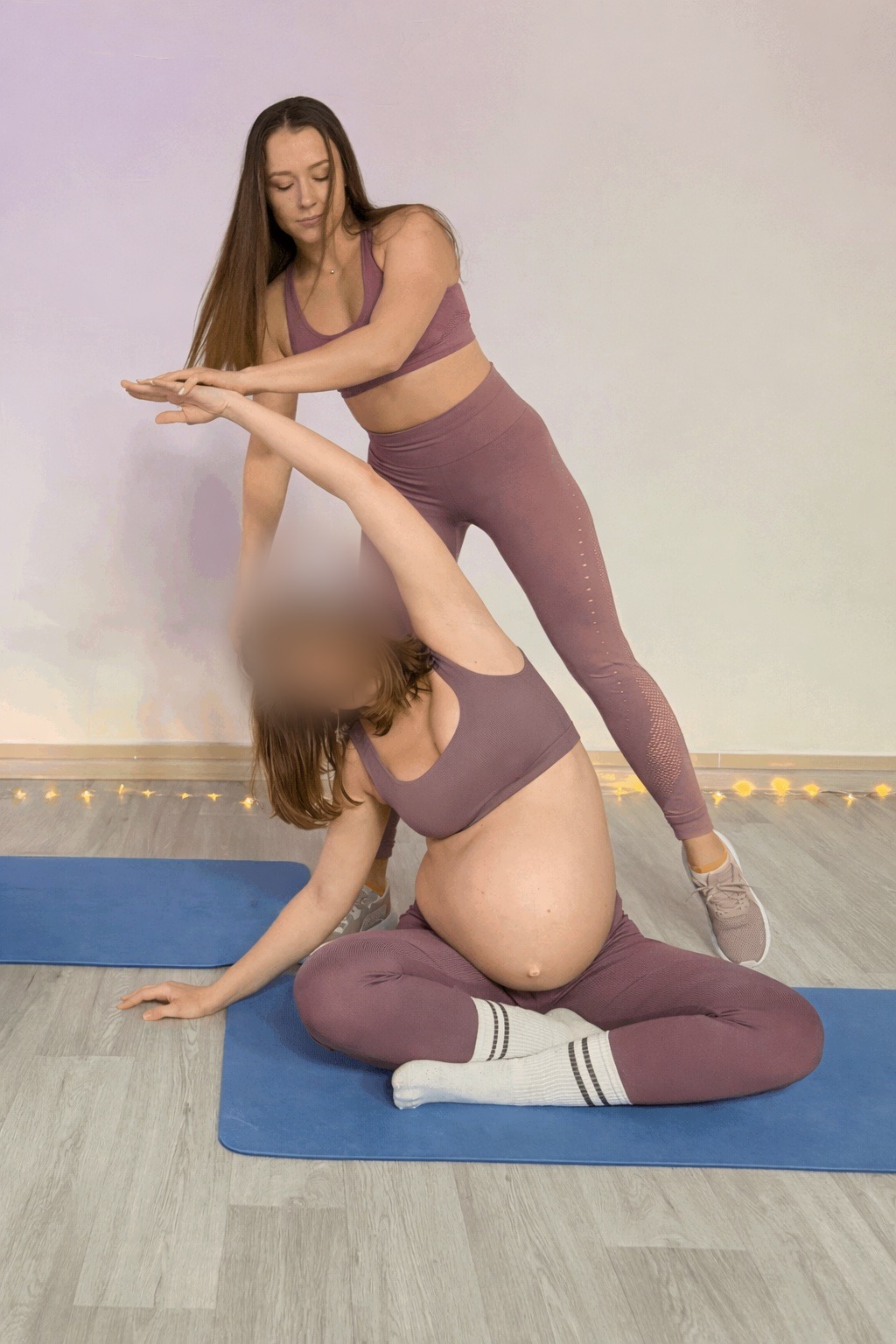
Why format matters
During pregnancy, your body goes through significant changes – and the load that felt normal before may no longer be appropriate or safe. That is why the format of training matters as much as the training itself: who leads it, how the program is built, and whether it accounts for your stage and how you feel.
Many women search for “pregnancy training” and find either group yoga classes or internet videos. But there is a significant difference between a general program and individual work – especially when safety is the priority.
When to start exercising during pregnancy
One of the first questions that comes up is timing: when is it safe to begin? The short answer is – only after your doctor has confirmed there are no contraindications. This is not a formality. Every pregnancy is different, and medical clearance is the essential first step before any physical activity.
For many women, the first trimester brings fatigue, nausea, and general sensitivity. This does not mean movement is off the table, but it does mean the body is signaling that it needs gentleness, not ambition. Light walking and breathing exercises are usually fine if you feel well enough, but structured training programs are typically introduced after the first trimester, once the pregnancy is more stable and energy levels start to recover.
If you were active before pregnancy, continuing some movement with appropriate modifications is generally considered safe – provided your doctor agrees. If you were not active before, pregnancy is not the time to begin an intense program, but it is a good time to start building a gentle foundation with the right guidance.
The key principle: begin when your body is ready and your doctor confirms it, not when a calendar says you should.
Types of safe activities
Not all forms of movement carry the same risk during pregnancy. Some are generally well-suited; others require significant adaptation or are best avoided entirely. Here are the types of activity that are commonly considered appropriate:
Walking. The most accessible and adaptable form of movement at any stage. You control the pace, duration, and terrain. Walking outdoors also supports mood and energy levels – both of which matter during pregnancy.
Swimming and water-based movement. Water supports your body weight, reduces joint stress, and helps with swelling. Many women find that movement in water feels lighter and more comfortable, especially in the second and third trimesters. The key is a comfortable temperature and a calm pace – no competitive laps.
Prenatal fitness with a qualified specialist. This means exercises specifically selected and adapted for pregnancy: controlled strength work, stability exercises, and movements that support posture and core function without creating excessive pressure. The emphasis is on safety, awareness, and gradual progression.
Stretching and mobility work. Gentle stretching helps manage tension in the back, hips, and shoulders – areas that carry more load during pregnancy. However, because hormonal changes increase joint mobility, stretching should be controlled. Feeling like you can go further than usual is not always a sign of progress – sometimes it is a signal to be more careful.
Breathing exercises. Mindful breathing supports pelvic floor function, reduces tension, and helps maintain the connection between your body and core. It is also one of the safest forms of movement at any stage.
The common thread across all of these: they can be adapted, scaled, and adjusted to how you feel on a given day.
Warning signs to stop
Knowing when to pause is just as important as knowing how to move. During pregnancy, some sensations are signals from your body that something is not right. If you experience any of the following during or after exercise, stop the activity and contact your doctor:
- Dizziness or feeling faint
- Vaginal bleeding or unusual discharge
- Contractions or a feeling of strong, rhythmic tightening
- Chest pain or difficulty breathing beyond normal exertion
- Severe headache that does not pass after rest
- Sudden swelling in the hands, face, or legs
- Leaking fluid
- Pain in the pelvic area, lower back, or abdomen that feels sharp or unusual
These are not signs that you did something wrong. They are the body’s way of communicating that it needs attention. A responsible approach to training includes knowing these signals and taking them seriously – without guilt or frustration.
A qualified specialist will always ask how you feel before, during, and after a session, and will adjust the plan if anything feels off. That ongoing conversation is part of what makes training safe.
How to gauge intensity
During pregnancy, the usual ways of measuring intensity – heart rate zones, percentages of maximum, fixed rep schemes – become less reliable. Your body is working harder at rest, your blood volume has increased, and your cardiovascular system responds differently than it did before.
Two simple and practical tools work well:
The talk test. If you can hold a conversation comfortably while exercising, the intensity is generally appropriate. If you are too breathless to speak in full sentences, it is time to ease off. This is not a precise metric, but it is a reliable everyday guide.
The RPE scale (Rate of Perceived Exertion). On a scale from 1 to 10, where 1 is complete rest and 10 is maximum effort, most pregnancy training should fall between 4 and 6 – moderate effort where you feel like you are working, but could sustain the pace for a while longer. Going above 7 is generally not recommended unless specifically guided by a specialist who knows your situation.
The goal is not to find the hardest workout you can tolerate. It is to find a level of effort that supports your body without depleting it. Some days that will feel like more, and some days it will feel like less – and both are perfectly fine.
What to look for
Personal approach
Safe pregnancy training is not a group class where everyone does the same thing. A good specialist considers your specific term, fitness level, and how you feel day to day. Questions a good trainer asks at the first meeting: how your pregnancy is going, whether you have any restrictions from your doctor, what your training background is, how you sleep, and how you feel overall.
Calm progression
A solid approach starts with a gentle entry into load. There is no need to “catch up” or prove your fitness. Load should increase gradually and only when you feel well. You can read more about what types of movement are usually appropriate at different stages in a separate article.
Awareness of limitations
A qualified specialist knows the difference between normal training discomfort and signals that call for stopping or adjusting. When medical restrictions exist, it is important to work within the trainer’s scope and recommend consulting a physician when needed.
What to avoid
- Group classes with no pregnancy adaptation
- Programs with sharp movements, jumps, or high intensity
- Specialists who do not ask about your condition
- Promises of “guaranteed results” or “fast recovery”
- Approaches that use the same scheme across different stages without adjustments
What the first meeting looks like
At the intro session, we review your situation: stage, how you feel, experience, limitations. It is not a workout – it is a calm conversation and basic assessment, after which it becomes clear what format of work suits you. Only then does the program begin.
What Anastasia Nikolskaya offers
In my work with pregnant clients, I use a personal approach: an intro session, intake form, movement check, and only then – a program adapted to your stage. Sessions are available in Samara and online, and the format and pricing are discussed at the intro session.
If you are looking for a safe and calm format of support during pregnancy, feel free to get in touch – I will help you find the right starting point.
This topic is also covered in my blog on T-Zh (in Russian): Training during pregnancy: medical guidelines and my practice.