Why pregnancy is not just about “going lighter”
A common approach to movement during pregnancy comes down to a simple formula: do what you were doing before, just at a lower intensity. That is better than stopping altogether, but it misses the point. Pregnancy changes not just how hard the body can work – it changes what kinds of movement are appropriate in the first place.
At different stages, the center of gravity shifts, joint mobility increases, pressure on the pelvic floor changes, and breathing mechanics are altered. A movement that felt comfortable in the first trimester may not be suitable in the third – not because it became “too hard,” but because the body is working differently. And the reverse is also true: some types of activity become especially helpful later in pregnancy.
So “just go easier” is not enough. What is needed is an approach that accounts for your specific stage, condition, fitness level, and goals.
What affects the choice of exercise
There is no single list of “allowed and not allowed” that works for every pregnant woman. But there are factors that determine what is appropriate for you:
Stage of pregnancy. The first, second, and third trimesters are different stages, with different possibilities and limitations. In the first trimester, fatigue and nausea often get in the way. The second usually brings more energy and mobility. In the third, the load on the pelvic floor, back, and breathing increases – and the program needs to reflect that.
How you feel. Even at the same stage, how you feel can change from day to day. A session that went well on Monday may be too much on Wednesday – and that is normal. The program should be flexible enough to adapt to your real condition, not just to the schedule.
Fitness background. A woman who was training before pregnancy and a woman starting for the first time are in very different places. That does not mean it is “too early” or “too late” for anyone. It means the starting load, rate of progression, and exercise selection will be different.
Medical picture. Uterine tone, placenta previa, risk of preterm labor, chronic conditions – all of these can change the acceptable level of activity. Information from your doctor here is not a suggestion – it is a mandatory starting point.
Type of movement. Not all forms of exercise are equally suitable during pregnancy. High-impact work, jumping, breath-holding exercises, lying flat on your back in later stages – these are examples of things that are usually excluded or modified. But the specific limitations depend on the individual situation.
What is usually appropriate
There are forms of movement that are generally suitable during a healthy pregnancy – provided they are adapted to the stage and how you feel:
- Walking. A simple and accessible form of activity at any stage. Pace and duration can be adjusted based on how you feel and the weather.
- Breathing work. Mindful breathing helps maintain the connection with your core and pelvic floor. During pregnancy, breathing patterns change – and it is helpful to work with this intentionally.
- Gentle strength work. Not heavy barbell training, but controlled movements with moderate load, adapted to your stage. The focus is on core work, posture, and stability.
- Pelvic floor work. The pelvic floor carries an increasing load throughout pregnancy. Maintaining its function is one of the key priorities.
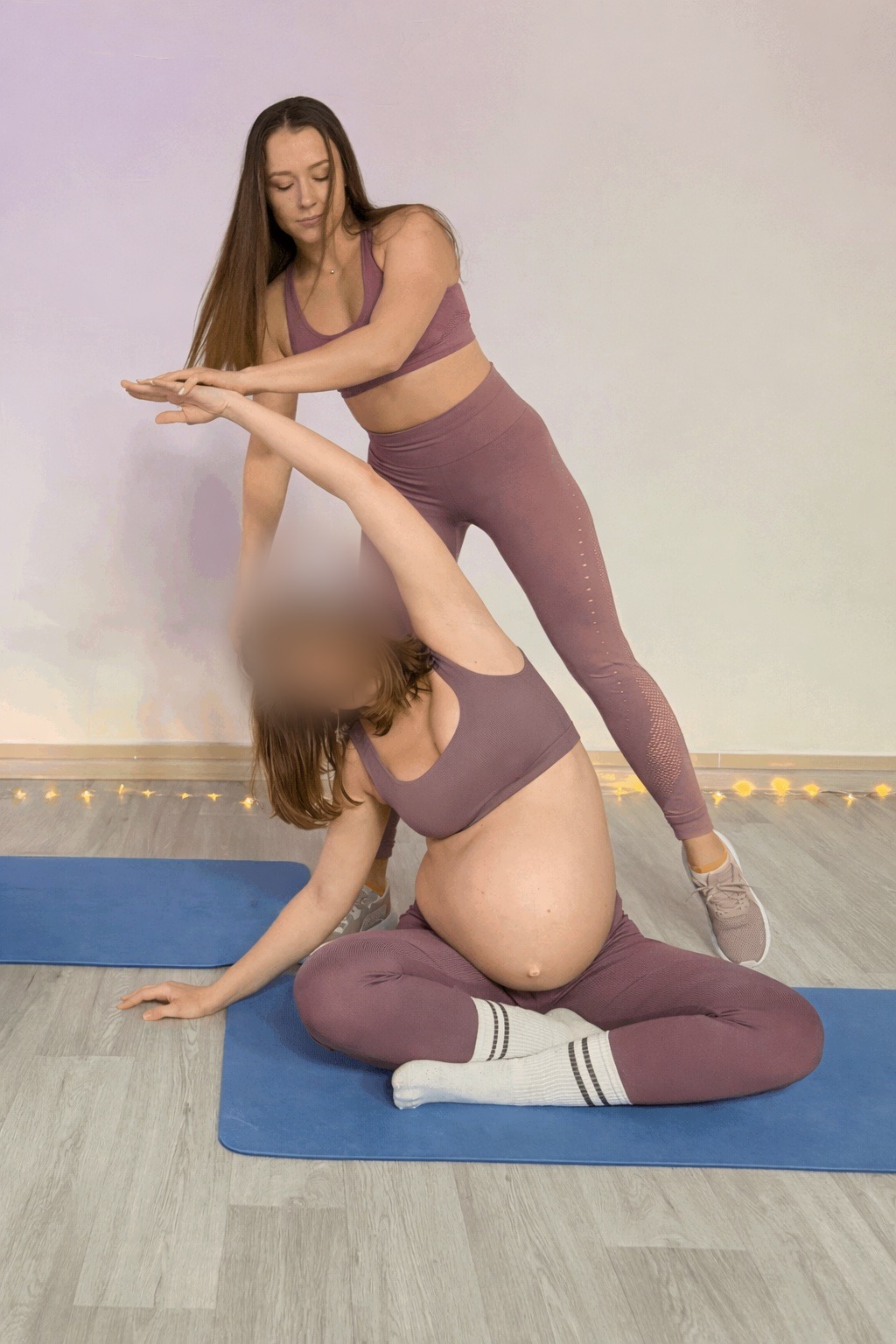
- Stretching and mobility. Given that hormonal changes increase joint mobility, stretching should be controlled – without pushing for maximum range. The feeling of “I can stretch further than usual today” during pregnancy does not always mean progress – sometimes it is a signal to be more careful.
What to approach with caution
Some things are not strictly forbidden, but during pregnancy they require caution or adaptation:
- Exercises lying on your back. In later stages, lying on your back can compress major blood vessels. This is usually dropped from the second or third trimester onward, but the timing varies individually.
- Intense core work. Crunches and similar movements create excessive intra-abdominal pressure. That is not what a growing belly needs.
- Jumping and high-impact work. Running, jumping, plyometrics – anything that creates sudden pressure on the pelvic floor. For most women in later stages, this is not suitable.
- Maximum effort. Breath-holding, straining, near-maximal lifts – these are typically excluded during pregnancy.
These limitations are not a prohibition on movement. They are guidelines that help you choose exercise consciously. Most of them can be adapted rather than simply removed – but that requires understanding the specific situation, not a generic list from the internet.
Why a trainer can help during pregnancy
Training independently is possible – many women do it. But a trainer who understands the specifics of pregnancy addresses several concrete needs:
- Adapts the program to your stage and how you feel in real time
- Helps you understand which sensations are normal and which signal a need to adjust
- Monitors technique – especially in exercises where breathing, body position, and pelvic floor pressure are critical
- Adjusts the program as the pregnancy progresses, rather than working from a fixed plan
A trainer does not replace a doctor and does not make medical decisions. But a doctor typically gives general clearance or restrictions – “you can exercise” or “avoid this.” A trainer translates that into specific exercises, pacing, and dosage that are both safe and useful for you at your current stage.
More about how training is structured during pregnancy on the During pregnancy page. About the approach to safety in the Safety and approach section.