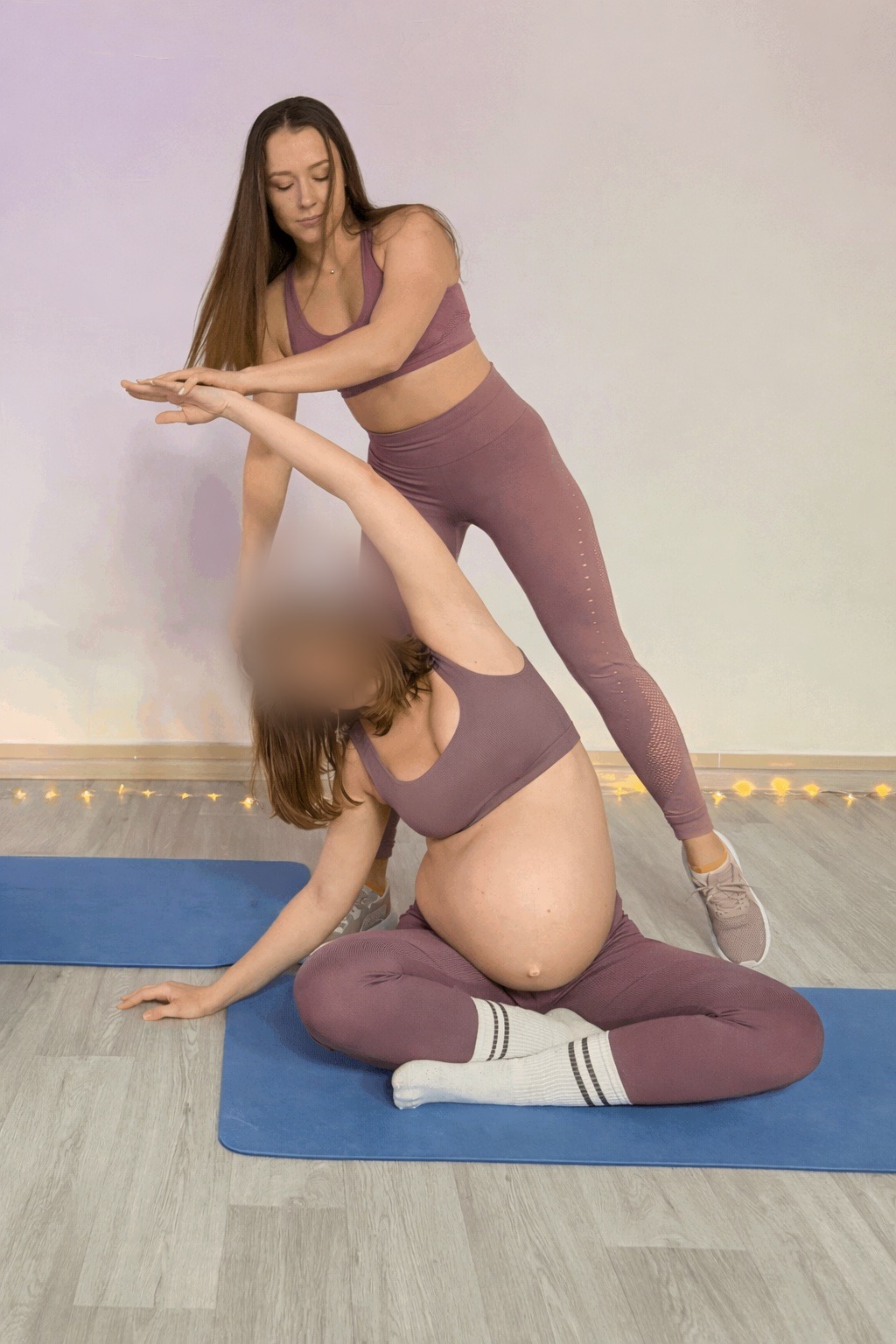
In brief. Postpartum recovery in Samara is not “the gym in a month” but proper work with the areas that actually took the hit: diastasis recti (present in most women who have given birth), pelvic floor weakness (leakage with coughing, heaviness below), back pain from changed posture, general weakness and reduced endurance. Starting timeline: after uncomplicated vaginal birth, gentle activity from 6-8 weeks and a doctor’s check; after a C-section – 10-12 weeks and clearance from the gynaecologist; with complications (tears, bleeding, hypertension) – individually. A trainer works with the body and exercises; a doctor handles medical questions (tissue healing, scar state, contraindications). The two roles do not overlap. A good trainer in Samara is recognised by requesting medical data, checking diastasis and pelvic floor at the intro session, refusing to work without medical clearance when there are complications, and not promising “your shape back in 3 months”. In Samara, in-person sessions at a studio, home visits, and online programmes are all available – the choice depends on childcare and schedule.
Postpartum recovery is not a return to “the old shape” but help for the body to reach a new balance: diastasis, pelvic floor weakness, and back pain require specific consistent work, not intensive fitness.
Birth is behind you, your baby is with you – and at some point a question appears: what do I do with my body now? The belly will not go, the back hurts, the muscles feel as if they have forgotten they exist. You want to get back in shape, but it is not clear where to start, when it is safe, and most importantly – who to see, if you live in Samara.
In this article we will look at how postpartum recovery works, what a trainer does and what a doctor does, which options are available in Samara, and how to choose a suitable format.
What happens to the body after childbirth
Pregnancy and childbirth are a serious load on the body. Over nine months the body rebuilds: the rectus muscles separate, the pelvic floor weakens, the centre of gravity shifts, posture changes. After birth all of this does not normalise in a week – it needs time and proper work.
Here is what usually concerns women in the first months postpartum:
- Diastasis – separation of the rectus abdominis muscles. Present in most women who have given birth; for some it closes on its own, for others it requires targeted work.
- Pelvic floor weakness – shows up as leakage with coughing or sneezing, a sense of heaviness in the lower belly, discomfort with physical load.
- Back pain – a consequence of altered posture and weakened core muscles.
- General weakness and lower endurance – the body has spent enormous resources and needs recovery.
All of this is normal and fixable. But the approach should be considered, not random.
When you can start recovery
There is no universal answer here, because everything depends on the type of birth and individual state. The general markers look like this:
After uncomplicated vaginal birth – gentle activity can start 6-8 weeks postpartum. Not gym training, but restorative breathing, pelvic floor work, and gentle deep-muscle activation.
After a C-section – timelines extend. The usual recommendation is to wait 10-12 weeks and obtain clearance from a gynaecologist. The scar needs to heal, tissues to recover. No rushing – but no postponing for years either.
With complications – timelines are discussed individually with a doctor. If there were tears, bleeding, or blood-pressure issues, the trainer does not decide alone and works only after medical clearance.
The key principle: not “when I feel like it” but “when the doctor cleared it and the body is ready”. The first step is a visit to the gynaecologist for a check – and only after that, planning a training programme.
What a trainer does and what a doctor does
This question comes up often, and the boundary is important. A postpartum recovery trainer is not a doctor. They do not diagnose, prescribe, do ultrasound, or perform examinations. Here is what falls within each role.
Doctor (gynaecologist, surgeon, urologist):
- Assesses the state of sutures, uterus, and pelvic floor from a medical standpoint
- Diagnoses diastasis, organ prolapse, inflammatory processes
- Grants or withholds clearance for physical load
- Refers to physiotherapy or surgery if needed
Postpartum recovery trainer:
- Builds an exercise programme taking the client’s state into account
- Works on strengthening the core, pelvic floor, and back
- Teaches correct breathing and deep-muscle activation
- Tracks progress and adjusts load
- Refers to a doctor if concerning symptoms appear
These specialists do not compete – they complement each other. The ideal scenario is when doctor and trainer work as a pair: the doctor gives recommendations, the trainer factors them into the programme.
Available options in Samara
In Samara, postpartum recovery can be organised in several ways.
Individual sessions with a trainer
The most effective format. The trainer works only with you, sees your technique, adapts the load, and accounts for everything. This matters most in the early stages, when mistakes in exercises can worsen the issue – for example, widening diastasis instead of reducing it.
Individual session prices in Samara vary from 2,000 to 4,000 rubles per session. With me, an individual online session is 1,700 rubles; at the studio – 2,100 rubles. The intro session is from 1,400 rubles (online) and is not a training session: it is a meeting, an assessment, and a plan.
Group classes
The city has studios that offer group classes for mothers after birth – usually pilates or yoga. Pluses: cheaper, community with other mothers. Minuses: the same programme for everyone, the trainer cannot give attention to each participant, no individual adaptation.
If you do not have diastasis, pelvic floor issues, or birth complications, a group format can be enough. But if at least one of these is present, it is better to start with individual work.
Online sessions
A relevant format for mothers with a small child. No travel, no schedule constraints, no need to find childcare. The session runs over video: the trainer sees you, adjusts technique, the programme is fully individual.
The online format works well if you have minimal space at home – a mat and a metre of free room – and stable internet. No special equipment is needed; the work uses bodyweight.
More on all formats – on the formats and pricing page.
Why an individual approach matters
Postpartum recovery is not a fitness challenge and not a weight-loss programme. It is work with a specific body that has a specific history. Two women after childbirth can look the same on the outside but be in completely different situations inside: one has a two-finger diastasis and a good pelvic floor; the other has minimal diastasis but significant pelvic floor weakness.
A programme that helps one can harm the other. That is why generic online routines are risky. They do not account for your situation, do not see your technique, and cannot adjust the load if something goes wrong.
An individual approach starts with assessment: what is your diastasis, how does the pelvic floor work, where are the weak zones, what restrictions did the doctor give. On that basis the programme is built – and it changes as you progress.
More on postpartum recovery – in the postpartum recovery section.
What not to do
A few common mistakes that drag out recovery or worsen the situation:
- Doing classic crunches – with diastasis this widens the separation. The abs need strengthening, but with other exercises.
- Rushing to the gym a month postpartum – early intense load can lead to injury and worsening of the pelvic floor.
- Ignoring symptoms – leakage, pain, downward pressure are not things that “pass on their own” but a reason to see a doctor.
- Comparing yourself with bloggers – social media often shows “ideal recovery in six weeks”. This is not the reality for most women and is a harmful benchmark.
- Waiting years for “it to recover on its own” – yes, the body has resources, but targeted work accelerates the process and gives better results.
How to start recovery
The first step is not a workout. It is a conversation. At the intro session we discuss how birth went, what the complaints are, what the doctor says, and what you want to achieve. I assess the state of your muscles and build a plan – with realistic timelines and clear steps.
If you are in Samara – we can train in person. If not – online works just as well.
Intro session – from 1,400 rubles (online). This is not a commitment to buy a package. It is a chance to understand what is happening with your body and to receive a specific plan of action.