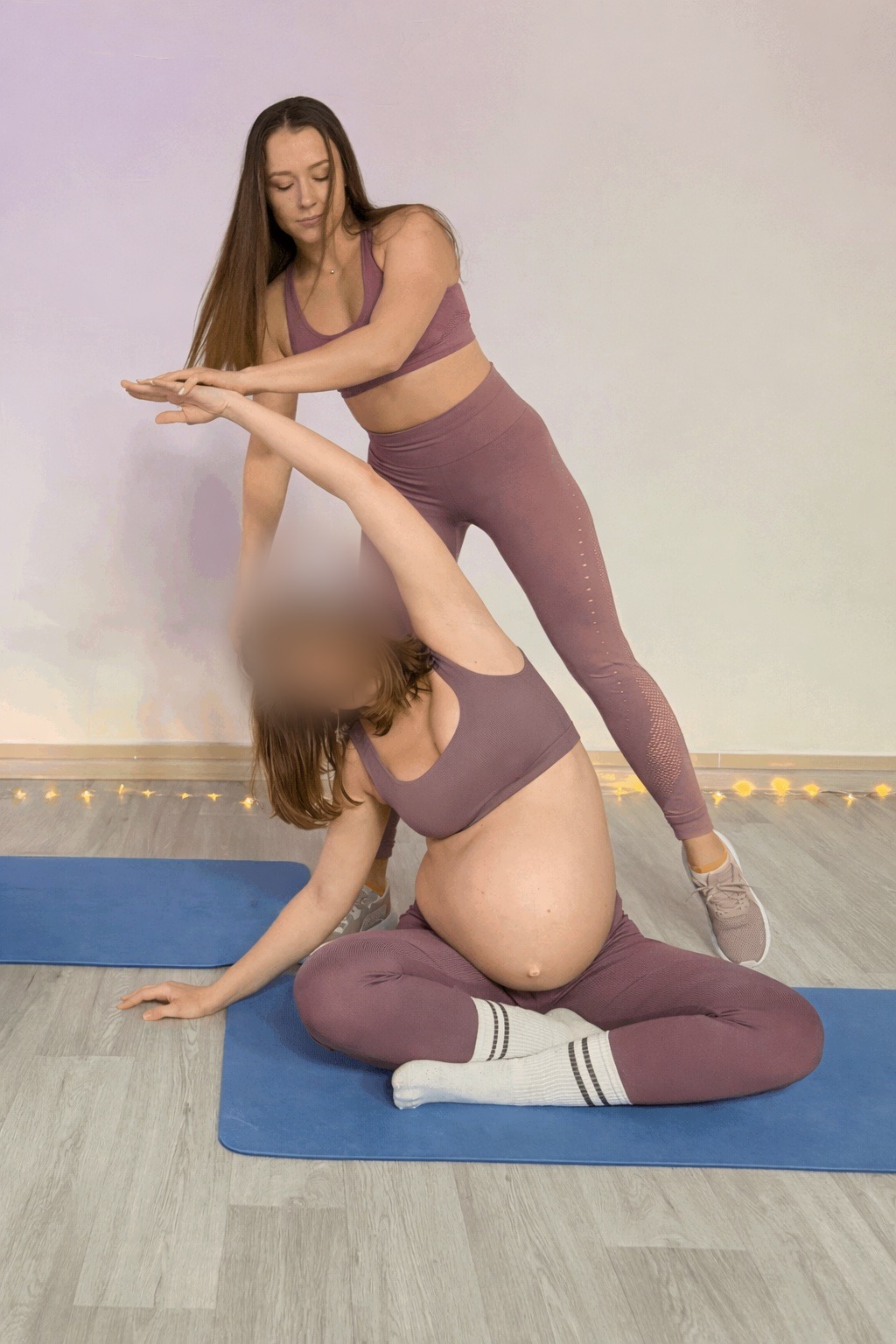
In short. Stretching during pregnancy is possible, but it is built differently from before. The hormone relaxin acts systemically: it softens ligaments not only in the pelvis, but also in the knees, ankles, shoulders, and spine – the sense that “I have become more flexible” is not an improvement in flexibility but a reduction in the natural stability of the joints. So we work more gently, without maximum amplitude, without jerks. By trimester: first – gentle work within a comfortable range, no ballistic movements; second – the optimal window for spinal and hip mobility, duration 15-25 minutes; third – short sessions of 10-15 minutes with support (wall, chair, fitball), focus on breathing and relaxation. Categorically excluded: deep splits, ballistic (bouncing) stretching, deep torso rotations, stretching with breath-holding, hot yoga, inverted poses without support, prolonged supine position after week 20. What it gives: less lower back pain, pelvic mobility for birth, less heaviness in the legs, postural support.
The feeling of “I have become more flexible during pregnancy” is not an improvement in stretch, but the effect of relaxin, which reduces the stability of all joints – working at maximum amplitude in this state crosses the line between flexibility and the risk of injury.
Why flexibility changes during pregnancy
Many pregnant women notice that the body has become more flexible than usual. The joints open more easily, familiar stretches feel simpler. It seems like a plus – but in fact there is a process behind this that requires attention and care.
During pregnancy the body produces the hormone relaxin. Its job is to soften the ligaments and connective tissue to prepare the pelvis for birth. The problem is that relaxin does not act locally but systemically: ligaments throughout the body soften – knees, ankles, shoulders, spine. This means that the joints become less stable, and the risk of over-stretching and injury rises.
The feeling “I have become more flexible” is not an improvement in stretch in the usual sense. It is a reduction in the joints’ natural protection. That is why the approach to stretching during pregnancy must be different: gentler, more careful, without striving for maximum amplitude.
What stretching offers during pregnancy
If you approach stretching wisely, it can be very useful throughout pregnancy. Here are the specific benefits you can get:
- Less tension in the lower back. As the belly grows, the centre of gravity shifts forward, and the lower back takes on extra load. Gentle stretching helps release accumulated tension.
- Better pelvic mobility. Soft exercises to open the hip joints help prepare the body for birth and reduce discomfort in the pelvic area.
- Less swelling and heaviness in the legs. Stretching the calves and the back of the thigh improves circulation and helps with the sense of heaviness.
- Relaxation and stress reduction. Slow, mindful stretches combined with breathing work as a gentle relaxation practice. This is especially valuable in periods of increased anxiety.
- Posture support. Stretching the thoracic spine and the front of the shoulders helps offset the slouch that increases as the chest and belly grow.
Stretching in the first trimester
In the first trimester the body has not yet changed much externally, but internal processes are well underway. The level of relaxin is starting to rise, although its effect is not yet very pronounced.
At this stage it is important to lay down the right habits:
- Do not try to improve flexibility. The goal of stretching in pregnancy is not to increase amplitude but to maintain comfort and mobility. If you did not do the splits before pregnancy, now is not the time to start.
- Emphasis on softness. Hold each position for 20-30 seconds without bouncing. Breathe calmly, do not force.
- Suitable areas: the back of the thigh, calves, thoracic spine, lateral torso bends, gentle opening of the hip joints.
- If you have nausea and weakness, postpone stretching until you feel better. Do not force yourself.
Stretching in the second trimester
The second trimester is often the most comfortable period of pregnancy. Nausea usually recedes, the belly is not yet too big, energy returns. This is a good time for regular gentle stretching.
What to consider at this stage:
- Avoid lying on the back after week 20. Prolonged supine lying can compress the inferior vena cava and worsen circulation. Use seated, standing, side-lying, or all-fours positions.
- Stretching on all fours is a great option. “Cat-cow” gently mobilises the spine and releases tension from the lower back.
- Add breathing work. Stretching combined with diaphragmatic breathing helps maintain the connection with the pelvic floor and core muscles.
- Pay attention to the pelvis and hips. Seated butterfly pose, gentle lunges with support, pelvic circles – all of these help maintain hip joint mobility.
- Do not stretch into pain. A pleasant pull – yes. Pain, burning, the sense of “about to tear” – no. Under the action of relaxin, ligaments may allow you to go too deep, and you will feel the consequences not immediately but several hours later or the next day.
Stretching in the third trimester
In the third trimester the belly is already significantly bigger, the centre of gravity has shifted, and breathing may be harder because of pressure from the uterus on the diaphragm. Stretching in this period is directed primarily at easing daily discomfort and preparing for birth.
Recommendations for the third trimester:
- Use support. Wall, chair, fitball, cushions – anything that helps keep balance and removes load. Balance in the third trimester gets noticeably worse, and falling is a real risk.
- Focus on breath and relaxation. Deep breathing in each stretch helps relax the pelvic floor and prepare the body for birth.
- Seated and side-lying positions. Stretching on the side with a pillow between the knees is a comfortable option for hips and lower back.
- Gentle squats with a wide stance. With support on a chair or wall – they help open the pelvis and stretch the inner thigh.
- Short sessions. 10-15 minutes regularly works better than 40 minutes once a week. The body in the third trimester tires faster, and long sessions can cause discomfort.
What to avoid completely
Some exercises and approaches carry more risk than benefit during pregnancy. Here is the specific list of what to avoid:
Deep splits and maximum amplitude. Relaxin makes ligaments pliable but not elastic. You can drop into a deep split, but the ligaments will over-stretch, and recovery after birth will be harder. A ligament injury is not “I pulled a muscle” – it is damage that takes months to heal.
Ballistic stretching. Bouncing, jerking movements – a categorical no. They create uncontrolled load on joints that are already less stable due to hormonal changes.
Deep twists. Intense torso rotations compress the belly and put pressure on the uterus. Gentle thoracic rotations are allowed, but deep twists involving the lower back are not.
Stretching with breath-holding. Any bearing down and breath retention raises intra-abdominal pressure. While stretching, breathe freely and evenly. If you cannot breathe calmly – you have gone too deep.
Hot yoga and stretching in the heat. Overheating is dangerous for the foetus, especially in the first trimester. The room must be at a comfortable temperature, without stuffiness.
Inverted poses without support. Headstand, shoulderstand, deep head-down bends – the risk of falling and dizziness is too high.
Technique and safety: how to stretch correctly
A few principles that will help make stretching safe and pleasant:
Breathe. This is not just a recommendation – it is the foundation. On the exhale, muscles naturally relax and the stretch deepens without effort. Inhale – preparation, exhale – gentle deepening. Never hold the breath.
Move slowly. Enter each position smoothly. Sharp movements with reduced joint stability are a direct route to injury. Exit the position as slowly as you entered.
Listen to your body. A sense of mild pull – good. Pain, tingling, numbness – a signal to stop. “I will tolerate a bit” is a poor strategy, especially in pregnancy.
Do not compare with “before pregnancy”. Your body is now solving a different task. What you could do before may be inappropriate now – and that is normal. Stretching during pregnancy is about comfort and preparation, not results.
Drink water. Dehydration intensifies muscle spasms and reduces tissue elasticity. Keep water nearby.
If something raises doubts – do not do it. It is better to skip one exercise than to deal with the consequences later. Safety is always more important than progress.
When it makes sense to work with a specialist
Stretching during pregnancy is not an area for experiments. If you have questions about exactly what suits you, how to adapt the load to a particular stage and to the features of your pregnancy, it makes sense to work with a trainer who understands the specifics of the perinatal period.
At the intro session we go through your situation: stage, wellbeing, experience, restrictions. Based on that, we choose exercises that suit you – not by a generic template, but taking into account how you feel right now. The intro session costs from 1,400 rubles (online). I work in Samara and online.
More about training during pregnancy is on the «Pregnancy» page. About the approach to safety and adaptation – in the «Safety and approach» section.