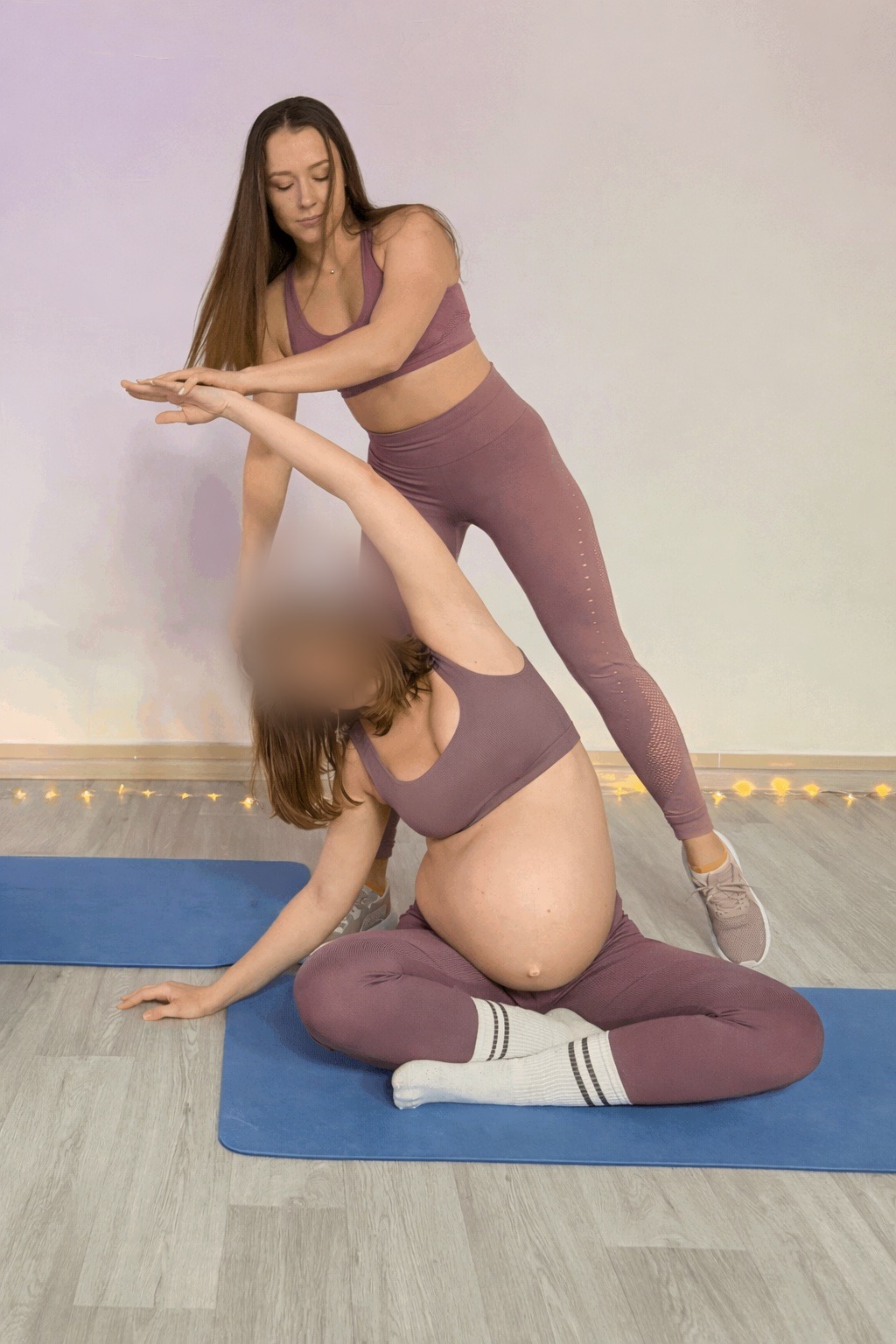
In short. One-on-one prenatal training is not a luxury but the optimal format for a pregnancy with specific features (uterine tone, symphysis pain, low placenta, gestational diabetes, age 35+, IVF history). Unlike a group class where the trainer runs 8–10 people at different stages and levels at once, individual work adapts the programme to the specific condition and how you feel in the moment: if you slept badly and your lower back hurts, the plan changes right in the session. Structure of an hour-long session: warm-up with breathing (10 minutes), main part focused on core, pelvic floor, back and legs (35–40 minutes), cool-down and stretching (10–15 minutes). The intro session is the mandatory foundation: assessment of mobility, muscle tone, breathing and posture. Prices: intro session from 1 400 roubles online, regular session 2 000–4 500 roubles. Group formats work for an uncomplicated pregnancy with training experience – there the saving is justified.
An individual prenatal session adapts in the moment to how you feel – in a group of 8–10 women at different stages this flexibility is physically impossible, and that is what makes the one-on-one format critical when pregnancy has specific features.
When a woman finds out she is pregnant, the question of physical activity comes up in a new way. Before, you could go to any group class, pick a programme by mood, try something new. Now you need to consider the stage, how you feel, medical recommendations – and understand that universal answers no longer apply. That is why one-on-one prenatal training becomes a conscious choice, not just a convenient option.
There are several options for expectant mothers: group classes in fitness clubs, yoga, aqua aerobics, online programmes. But not every one of these formats can account for the specifics of your pregnancy. This article looks at why an individual approach often turns out to be more reliable and safer, how such sessions go, and what to look at when choosing a specialist.
Why one-on-one work is not a luxury
Group classes for pregnant clients are fine. But they have an objective limit: the trainer works with several people at once and physically cannot give each one the same attention. If a group has ten women at different stages with different training backgrounds and different states – the programme will be average. For some it will be too easy, for others too heavy, and for some, individual exercises will simply not be appropriate.
In a one-on-one session it is different. The trainer only sees you, watches technique in every movement, asks about sensations and adjusts the load in real time. If you feel great today – you can work a little more actively. If you slept badly and your lower back hurts – the programme changes on the spot. This flexibility is impossible in a group but critical during pregnancy.
Another factor: safety. Pregnancy is not one state but a whole spectrum of situations. Uterine tone, symphysis pain, low-lying placenta, gestational diabetes – each of these changes the list of allowed exercises. In a one-on-one session the programme is built with all the details in mind, and the trainer is always aware of your current medical recommendations.
What a one-on-one session looks like
Many people imagine intense sessions with heavy dumbbells – that is not what prenatal fitness is. A one-on-one session for a pregnant client is calm, thoughtful work with the body, where every movement has a clear purpose.
The intro session
It all starts with an intro session – not a workout but an introduction. The trainer asks about your stage, how you feel, the specifics of your pregnancy, your movement background, your daily life. Asks for medical clearance. Assesses your current state: joint mobility, muscle tone, breathing, posture. Based on that, they build a programme that will be updated as your stage and how you feel change.
The intro session is not a formality but the foundation of all the work that follows. Without it you cannot build a safe and effective programme. The intro session is from 1 400 roubles (online).
Session structure
A typical session lasts 50–60 minutes and includes several blocks:
-
Warm-up and breath set-up. Gentle movements that help the body get going. Working with breath is not a formality but a key tool for preparing for birth and supporting deep muscle tone.
-
Main part. Exercises to strengthen the core, pelvic floor, back and legs. Everything is adapted to the current stage. In the second trimester the focus may be on strength and mobility, in the third – on breathing, relaxation and birth preparation.
-
Cool-down and stretching. A gentle finish that helps release tension, improve circulation and simply close the session pleasantly.
Between blocks the trainer keeps checking how you feel. If anything causes discomfort, the exercise is changed or removed. That is normal and correct.
How the programme adapts to different stages
One of the main advantages of individual work is that the programme is not static. It changes with your body.
Second trimester (14–27 weeks) – usually the best time for active training. Nausea has faded, energy is higher, the belly is not yet too large. Here you can work on strength, hip mobility, back strength. This is the period when the body gets the most benefit from movement.
Third trimester (28+ weeks) – intensity goes down, but training does not stop. The focus shifts to breathing techniques, pelvic floor work, gentle mobility and preparing the body for birth. Many exercises are done seated or on the side – and this is absolutely normal.
Special situations. If a doctor identifies any restrictions, the trainer adapts the programme. For example, with symphysis pain all wide-leg movements are removed. With uterine tone, ab work is reduced. With gestational diabetes, more gentle cardio is added. None of this can be done in a group format.
Local context: what to keep in mind
The prenatal fitness market is not as developed everywhere as in the largest cities. This has a few practical implications.
First, there are not many trainers who specialise in pregnancy. Not every fitness trainer has specialist prenatal education. A standard certificate is fine but not enough. Working with pregnant clients requires specific knowledge: how the body changes, which exercises are safe at each stage, how to work with the pelvic floor and breathing.
Second, many trainers offer “prenatal training” as a side service, not as their main specialisation. The difference is like that between a generalist and a specialist. Both have their place, but in pregnancy it is better to work with someone who is deeply versed in this specific topic.
Third, there is a plus: individual training outside the largest cities is more affordable. The price per session starts at reasonable numbers, which allows you to train regularly rather than occasionally.
More on formats and pricing on the formats and pricing page.
One-on-one vs group: an honest comparison
To make it easier to orient yourself – the main differences:
Personalisation. A one-on-one session is built around you. A group session is a compromise for everyone.
Safety. The trainer watches every movement of yours. In a group, control loosens.
Flexibility. One-on-one sessions are easier to fit into your schedule. Group ones are tied to the club’s timetable.
Adaptation. An individual programme adjusts in a minute. In a group you decide for yourself what to skip.
Cost. More per session, but every minute serves your goal. Group sessions are cheaper, but effectiveness may be lower.
Connection. A group gives contact with other mothers. One-on-one sessions are focused work. Both formats can be combined.
How to choose a one-on-one trainer
Specific questions to ask at the intro session:
- What is your education in prenatal fitness?
- How many pregnant clients are you working with or have you worked with?
- How do you build the programme and how often is it revised?
- Will you ask for clearance from my doctor?
- What will you do if my state worsens during a session?
- Do you work with pelvic floor and breathing, or only with general physical form?
If the trainer answers confidently and specifically – that is a good sign. If they slip into general phrases or get offended at the questions – keep looking.
More on working with pregnant clients, the approach and safety principles – on the pregnancy page.
Online or in-person
Both formats are available. In-person sessions let the trainer check body position and help with technique. Online is convenient at a late stage or in bad weather. Many start in person and switch to online closer to birth.
Conclusion
One-on-one prenatal training is not a privilege but a sensible choice for those who want to move safely, taking into account the specifics of their body and stage. The format is affordable both in price and logistics – you just need to find a trainer with the right qualifications and approach.
If you would like to try but do not know where to start – book an intro session. It is not a workout but a calm conversation: we discuss your state, goals, concerns and build a plan. The intro session is from 1 400 roubles (online).
You can book through the site or message directly. Sessions are available in Samara in person and online.